Are you better yet? The long road of mental health recovery

Are you better yet?

No one has actually asked me this question because my friends and family are more considerate than that, but I know it’s a question that’s itching in their minds and if they weren’t sensitive to my illness they may actually ask it. I’m extremely lucky to have colleagues who have become good friends and despite my absence from work, we still manage to get together once in a while. When I met with them last week, they asked about my health in a kind and unobtrusive way. They asked how I was feeling, never asking when I would return to work. Still, I felt like the question of, “are you better yet?”, was hanging in the air, just waiting to be given voice.

DSC01266_edited-1_thumb[15]Or maybe it’s all in my head. Maybe I only think other people want to ask that question  because I’m wondering, am I better yet? Could I return to work? And what happens when I eventually do return? Will I be treated any differently than before? Will I be perceived as broken and damaged, or worse, weak?

Despite being absent from work for three months, I’m still feeling embarrassed and guilty that I had to take time off to tend to my mental health. I know I shouldn’t feel this way because it’s just as legitimate as taking a leave because you are physically sick. But reality doesn’t  change the way I feel.

When I met with my friends/colleagues (frolleagues?) I found out that my favourite project has been passed off to someone else. I assume it’s because I’m not there to take care of it, and that is disappointing, but also understandable. It’s a massive undertaking and requires a lot of planning that I’m not there to do. There’s always next year, I guess.

This is the reality of having a mental illness. The world doesn’t, and can’t, stop just because your brain breaks. It doesn’t matter if you’re hospitalized, catatonic with depression, or losing touch with reality because of mania; the world keeps moving without you and I think that’s the hardest part for me to come to grips with. It irks me knowing that someone else is working on this project and that if I could have survived just a little longer it could be me working on it.  Or if I could have just returned to work already, maybe they would have held out a little longer before replacing me. But it’s this type of thinking that got me into this mess in the first place.

Mental healthy recovery is a long journey.

Mental healthy recovery is a long journey.

Of course, I already had the existing condition of bipolar disorder, but it was my inability to disengage with work, share the load, and ask for help when I was floundering that pushed me over the edge. I wanted (and still want) to please everyone and show them (and myself) that I’m strong enough to do it all, despite my mental illness. Except even those without mental health issues can’t do it all without eventually breaking.

Also, if I’m 100 per cent honest with myself I know I couldn’t return to work full-time tomorrow. My body is still getting used to a new medication regimen, which means my moods are still up and down. I still struggle with simple tasks and become easily overwhelmed (writing this blog has been a chore rather than something I enjoy). I cry very easily and can’t manage stress. I wouldn’t last a week at work before I was back at square one, or worse. Now that I have three months distance from where I started, I can recognize that I was skating on thin ice for a long time. As I persevered through the stress, taking on more and more projects, the ice was cracking beneath me as I skated along, pretending that nothing was wrong. I was just lucky that I caught myself before the ice broke and I ended up in the hospital.

So, I guess if anyone is wondering if I’m better yet – no, not yet. But I’m getting there.

Why self-harm?

Trigger warning: This post discusses in detail someone engaging in self-harming behaviour.

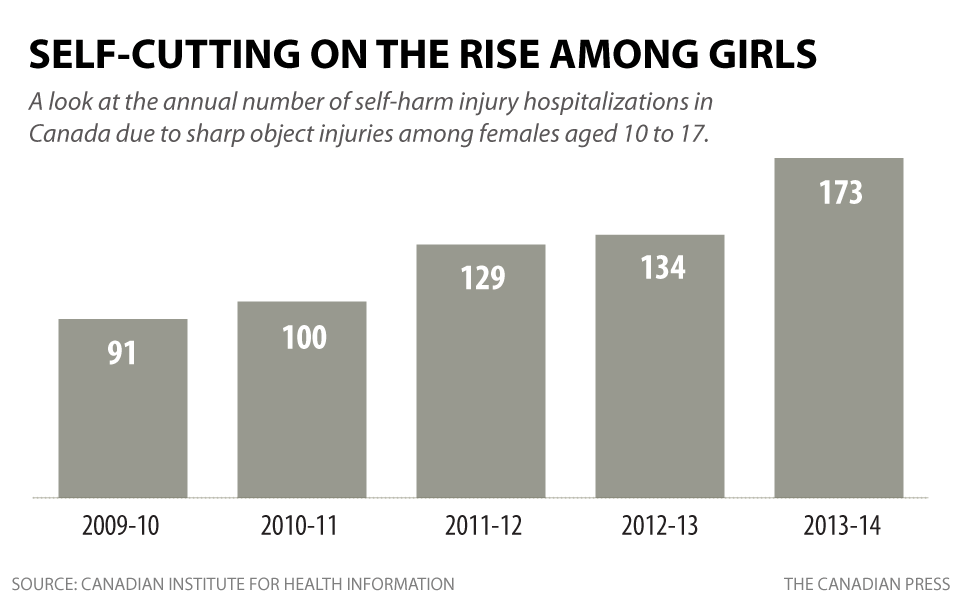
The Canadian Institute for Health Information (CIHI) recently released new statistics on self-harm among Canadian teens. The CBC reported that in 2013-2014 one in four hospitalizations among youth age 10 to 17 were due to intentional self-harm injuries. But even more shocking than that is that self-harm hospitalizations for girls saw an increase of 110%, according to CTV News. Although self-harm hospitalizations also increased among boys in this age group (up 35%), the rate of growth isn’t nearly as staggering. I find these numbers so concerning, and unsurprising, because I could have easily been one of these statistics.

Source: Canadian Institute for Information

Source: Canadian Institute for Information

For the uninitiated, self-harm behaviour can include cutting, burning, hitting or punching yourself, intentionally preventing wounds from healing, and self-poisoning. However, binge drinking, drug use, and reckless driving can also be forms of self-harm.

I engaged in the most common self-harm behaviour, cutting, although I was a bit older than the demographic the CIHI reported on. I was eighteen and in my second year of university when I first resorted to cutting. It was during a time when I was struggling to adjust to university life after the summer off. I was living in a house with five other girls and had little patience or time for their antics. I was finding it almost impossible to keep up with my full course load and I was dealing with a long distance relationship. It doesn’t sound like an unusual stress for an eighteen year old and it isn’t, but what I have learned over the years is that some of us have a capability to bear more stress than others.

I was two months into the semester when I started to isolate myself. I’d close my bedroom door and stay there for most of the day. I stopped eating, I skipped lectures and slept all of the time. When I wasn’t sleeping, I was crying. Now I know these are all symptoms of depression, but at the time I had only a vague inkling of depression. I thought that depression was a profound sadness that happened after a traumatic life event, like someone dying. Nothing like that had happened to me. For all intents and purposes, I should have been happy. I should have been enjoying university life. But I wasn’t.

I try to think back to what compelled me to start cutting and honestly, I have no idea. I never had a friend who engaged in self-harm. It wasn’t like today with self-harm blogs pervading the internet. All I remember is that one night when I couldn’t sleep, I found myself in the kitchen with a knife. I looked from the blade to my arm and knew what I was going to do. I dragged the blade across my skin. The burning pain jolted me back to life like an electric shock. As I watched the blood well up, I felt better. I could breathe. It was like the cut was a release valve and the pressure that had been building inside of me finally had a way to escape. So I made another cut and another. Each cut releasing my anxiety like air leaving a balloon. After that moment, I was hooked.

tumblr_mgyxj5YpjA1rddtbco1_1280When my friends, family, and partner saw the cuts, it scared them (as it should). They assumed (mistakenly) that I was trying to kill myself, but that’s not what most instances of self-harm are about. Non-Suicidal Self Injury is more about manifesting your psychological pain into something physical. I didn’t understand why I was hurting so much and I couldn’t find the words to talk about it, so cutting was a method of expression.

I learned through therapy that self-injury is an unhealthy coping mechanism, just like someone who drinks or does drugs. However, what I was never told was that it could be addictive like drugs or alcohol. I used to promise my partner and parents that I wouldn’t do it again, but like an addict I broke those promises over and over again. The lure of the blade would beckon to me in my pain. It didn’t matter that I was lying or breaking a promise to those that I loved; I had an itch and it needed to be scratched. It was only once I entered an intense inpatient therapy program that I finally broke the habit.

It’s been over five years since I last cut and my scars have mostly disappeared, but truthfully, in my most anxious moments, my mind instinctively thinks about cutting. But instead of trying to fight it, I give myself five minutes to think about it and then I replace it with a healthy coping mechanism, like writing or telling someone I’m struggling.

Ultimately, I was very lucky because my self-injury never led to a hospital visit. But, as the statistics show, not everyone is so lucky.

What are some of the warning signs that a friend or family member may be engaging in self-harm? (from helpguide.org):

  • Unexplained wounds or scars from cuts, bruises, or burns, usually on the wrists, arms, thighs, or chest.
  • Blood stains on clothing, towels, or bedding; blood-soaked tissues.
  • Sharp objects or cutting instruments, such as razors, knives, needles, glass shards, or bottle caps, in the person’s belongings.
  • Frequent “accidents.” Someone who self-harms may claim to be clumsy or have many mishaps, in order to explain away injuries.
  • Covering up. A person who self-injures may insist on wearing long sleeves or long pants, even in hot weather.
  • Needing to be alone for long periods of time, especially in the bedroom or bathroom.
  • Isolation and irritability

If you suspect someone is engaging in self-harm behaviour, here are some ways you can help support them from Befrienders.org):

  • Ask how they are feeling
  • Do not be judgmental
  • Do not make them feel guilty about the effect it is having on others
  • Let the person who self-harms know that you want to listen to them and hear how they are feeling when they feel ready and able to talk.
  • When they do discuss it with you be compassionate and respect what the person is telling you, even though you may not understand or find it difficult to accept what they are doing
  • Do not give ultimatums such as ‘If you don’t stop self-harming you have to move out’. 
  • Understand that it is a long and hard journey to stop self-harming. Be aware that someone will only stop self-harming when they feel ready and able to do so.

This post originally appeared on Healthy Minds Canada.

Pregnancy & mental health; or how one psychiatrist told me I shouldn’t have kids

When I participated in an inpatient program, I met a woman whose family had a doctor perform a full hysterectomy on her when she was eighteen (she was now in her late fifties) because of her bipolar disorder. Her family and doctor both believed that she would be an unfit parent and they didn’t want to risk her having a child that could also develop the disorder. I was terrified by this story. This woman had not only endured a debilitating mental illness, but she had to endure it when compulsory sterilization was a reality for those in psychiatric hospitals.
quotes-1109Fast-forward to 2012, a Massachusetts woman with bipolar disorder and schizophrenia was forced to have an abortion and be sterilized. In 2013, an Italian-born woman had her baby forcibly removed by ceasarean and taken into child services by the UK government because of her mental illness.

As a woman who is married and still deciding whether or not I want to have children, the stigma toward pregnancy, motherhood, and mental health is concerning. But until two years ago, these were just stories I had heard or read about. Then I had my own, although much less traumatic, experience.

It was December (I remember because it was my birthday) and I had a consultation with a new psychiatrist. Like I said in a previous post, I’ve never met a psychiatrist I liked and I was certain this was going to be just another name on my list. I never thought it would probably be among the worst psychiatrist visits in my life.

As I sat in the waiting room, I knew who was waiting for me. It was undoubtedly going to be a man (they’re always men). He was going to have glasses (they always have glasses). He was going to be slightly disheveled (they’re always disheveled). He was going to ask me questions about my history that I feel guilty and embarrassed about. I was going to cry. He’d ask me why and I’d incoherently try and explain myself through my tears. It would be awful, but then it would be over.

You might be wondering, why is a psychiatric assessment so terrible? It’s because it’s not just just a doctor glancing at that mole on your shoulder. You’re sharing your most personal and more often your most shameful experiences.

Facepalm

When it’s so embarrassing, you need a double facepalm.

Imagine the most embarrassing moment of your entire life. Maybe it was that time you farted during your sixth grade presentation or that day in tenth grade when you walked around with your skirt tucked into your tights ALL DAY. Whatever it is, imagine that moment and remember the fear of judgement, the embarrassment, and the shame you felt. Now imagine retelling every mortifying moment to a stranger on the bus.

And you’re not just retelling the story to a passive audience, your listener is asking questions. What did the fart smell like? What did you have for lunch that day? Have you ever farted in public before then? Does your family have a history of public farting?

These questions make you relive not only the embarrassing moment itself, but all of the moments that led up to the incident. Now you regret eating beans at lunch because you should have known better. Your family has always whispered about your Uncle Frank’s 1965 broccoli incident.

And as he asks the questions and you answer, he takes notes. Endless notes. You try and peer over his clipboard to see what he’s scratching, but you can’t see. He holds it close to his chest. And with those notes, he makes files – files that you are never privy to – even when you ask (trust me, I’ve asked).

That’s what makes the process of retelling your history to one psychiatrist excruciating.

When my name was finally called, I followed him into the office that now felt claustrophobic with the two of us inside. I quickly launched into the gory details of my illness. (It’s like ripping off a bandaid – do it quick and the pain lasts only a second).

We sit silently for a moment as I dig through my purse looking for a tissue (it’s not a psychiatrist visit without some tears!). Just as I find an errant tissue, he inhales and asks, “Are you thinking of becoming pregnant?”

I pause, momentarily stunned by the question. I’d seen a lot of psychiatrists, but none of them had ever asked this before. After a moment, I reply. “Not any time soon.”

“You know it’s dangerous to become pregnant while on these medications,” he replies, ignoring my response as he makes more notes on his clipboard.

“Yes, I know the risks involved.” My back is up, I’m feeling defensive. “But I’m not thinking of getting pregnant soon.”

“Good, because it’s dangerous and not just for you. We don’t know the risks of medication use on the foetus. It could cause birth defects and other issues. It’s not 100% but there’s still a risk. You need to know all of this before you become pregnant.”

“Yes, I’ve spoken to my doctor about it before. But since I’m not planning on getting pregnant any time soon, we figured we could revisit the issue when I’m making that decision. I don’t even know if I want kids anyway.”

He looks up at me, cocks his head to the side and adjusts his glasses before looking back down at his clipboard. “You know that your disorder is genetic.”

I nod, feeling my cheeks flush. He interprets my silence as misunderstanding. (I forgot to mention that psychiatrist’s are always condescending too).

“That means that it’s passed down,” he speaks slowly, emphasizing every syllable, “through the family…”

“I know what genetic means,” I spit through my teeth. There’s nothing worse than people thinking that you’re stupid.
“So you know that there’s a possibility that your child could turn out like you.”

10712840_10100467498047785_6912168116314759968_n

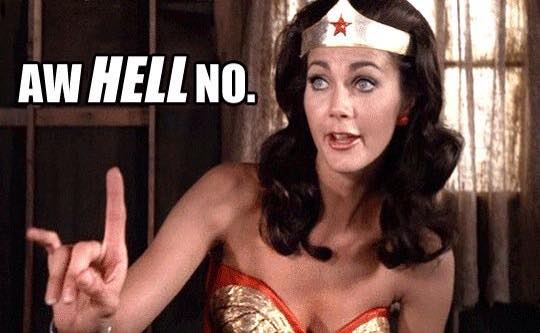
Wonder Woman perfectly encapsulates my outrage

I stare at him aghast, floored by the words coming out of his mouth. Apparently he thinks I’m some kind of monster that shouldn’t procreate! Would it be so terrible if I had a kid and they had bipolar disorder? I wouldn’t wish my disease on my kid, but my life isn’t horrible. And I imagine that if my child did have a mental illness, I’d have the tools to help them cope.

I suddenly tried to imagine my life without children. Where once it seemed like a choice, now it seemed like it was something being forcibly taken away from me. Anyone who knows me knows that I hate being told what to do and this doctor was suggesting that I shouldn’t have children.

For the first time in my life, I desperately wanted children. I wanted a hoard of them. I wanted to raise them to be healthy and happy and then I wanted to thrust their beautiful cherub faces at him as proof, see they’re fine! I can be a mother!

I was so angry, and hurt, and completely shocked by his implications that I don’t even remember how the appointment ended. All I can remember is leaving the hospital with tears streaming down my face, thinking, it’s my birthday. He ruined my birthday.

It’s been two years since that appointment and I have shared this story repeatedly to illustrate the pervading stigma and fear that exists towards those with a mental illness. My experience is no where near as traumatic as someone who was given a forced hysterectomy or a forced abortion through the collusion of families, friends, and doctors. But I tell this story to illustrate the point that medical professionals are still deeply uneducated when it comes to discussing mental health and parenthood. These comments came from a man who is supposedly educated in the field. This is a man treating a vulnerable population. This is a man who is using his authority to spread fear and misinformation.

Although my husband and I still haven’t decided if and/or when we’ll have children, the hurt and anger of this encounter linger. Some days, when I see my friends with their babies, I think “I could do that. I could be a mom one day.” And then I hear his voice, “but they could turn out like you…”

How Clara Hughes inspired me to share my story

Last Monday, I had the amazing opportunity to meet Clara Hughes, a mental health advocate and six-time Olympic medalist, at Montreal’s Jewish General Hospital (JGH). Hughes has been my inspiration and gave me the courage to speak out about my own struggles with mental health. She is akin to a mental health rockstar to me.

The Jewish General Hospital awarded her with the Douglas Utting Medal for her work in the field of mental health. For the past five years, she has been the national spokesperson for Bell Canada’s Mental Health ‘Let’s Talk’ campaign. This year, she and Bell also launched Clara’s Big Ride which was a 110-day, 12, 000 KM stigma busting journey across Canada.

Me and Clara Hughes - I got a little teary meeting her.

Me and Clara Hughes – I got a little teary meeting her.

During her talk, Hughes didn’t dwell much on her sporting success. Instead she spoke candidly about her family life in Winnipeg with an alcoholic father who was verbally abusive to her mother. She spoke about following in the “delinquent footsteps” of her sister (who has now been diagnosed with bipolar disorder). She spoke, with a shaky voice and tears in her eyes, of the moment that changed her life; the moment she watched Olympic speedskater Gaétan Boucher in the 1988 Calgary Winter Games.


“It was the most awesome thing I had ever seen in my life and I knew that I was going to skate for Canada one day,” Hughes said.

But that moment wasn’t the end of her struggle. Hughes took a detour on her speed skating career with cycling. She was trained by an uncompromising and emotionally abusive coach, Mirek Mazur:

“On my way to the Olympics I was beaten down emotionally. I was too fat, too slow, too awful. [Mirek] gave me an eating disorder. Since I grew up in an environment of abuse that abuse was comforting. I turned into a training junkie. A winning junkie. I had a collection of medals and it was never enough. I was never enough. I thought once I made it to the Olympics I would finally feel like it would be good enough. But it wasn’t. I won two bronze medals. These medals were nice for everyone else but why did I still feel like garbage?”

These words struck a chord inside of me. My life and Clara Hughes are are vastly different. I’ve never been remotely athletic and my childhood wasn’t nearly as difficult as hers, but still there is a vein of similarity in our stories. I certainly wasn’t emotionally abused by my parents or a coach, but I was bullied relentlessly in school.

Teenage girl being bulliedFor anyone who thinks that bullying is a rite of passage in childhood, it isn’t. It isn’t natural for a sixth-grader to deal with death threats from other children, it isn’t natural to have rocks thrown at you during recess, it isn’t natural to have people trashing your school supplies and clothing, and it definitely isn’t natural to have chants made up about you.

To this day I remember seeing MSHMENTOS written on every chalk board and bathroom stall. It was an acronym for Marisa Sucks Her Mom Every Night and Twice On Sunday. As an adult, it’s gibberish and incredibly childish, but in eighth grade it was the epitome of humour and insult.

I am so grateful that I grew up pre-social media because if these kids could have invaded the safety of my home, I don’t know if I would be alive today.

The worst part was that it wasn’t just one school where this happened. It wasn’t the same kids. We moved a lot and I went to six different elementary schools. Each time I changed schools, I always thought that this time would be different. I would be different. But it didn’t matter where I went – there were always bullies in the schoolyard and I was always the target. The thing is, to this day, I still have no idea why. These girls who ended up tormenting me always started as my friends. Had I done something to them and had no idea? Or was I just an easy target because I was tall, chubby, and sensitive?  Or did it have nothing to do with me and was just a result of a bunch girls with low self-esteem?

And you might be wondering, why didn’t my parents intervene. Because I didn’t say anything. They knew I was having a rough time at school, but I kept quiet about the worst bits of torment. They didn’t know I had to hide in the bathroom at lunch. They didn’t know I used to walk the schoolyard socializing only with a teacher on duty because I knew they wouldn’t physically hurt me in front of a teacher. They didn’t know about the death threats. As most kids think, telling your parents will only make the situation worse.

So how does this relate to Clara Hughes and her feeling like garbage after winning two bronze medals? The constant emotional abuse I suffered at the hands of other children has created a hole, an emptiness in my soul. As an adult I try and fill that emptiness with achievements, the praise of other people, and making other people happy (often at the expense of my own happiness).

Me at my BA convocation...ignore the wind!

Me at my BA convocation…ignore the wind!

In school, no grade was ever good enough. I used to make myself sick over my report cards. Going to university and getting a Bachelor’s degree wasn’t good enough, I had to get a Master’s Degree. But even that wasn’t enough. I was supposed to get a PhD (until my illness got in the way) and I still struggle with the fact that I’m not Dr. Lancione. The Dean’s List, honour roll, all of those things that my parents are incredibly proud of mean nothing to me.

Today I can’t just be okay at my job, I have to be the best. I have no tolerance for anyone who is mediocre at their job. I’d rather do it all myself and know that it’s being done right than depend on another person because people are inherently untrustworthy. I take criticism personally because everything I do is a reflection of how good I am.

And like Hughes and her medals, it’s never enough.

I’m an adult and I should be over this by now, right? Absolutely. I have spent 10 years in therapy working on these issues but they are so deeply ingrained in my soul that I wonder if I will ever get over them. Moreover, I wonder if my genetic predisposition to bipolar disorder would have manifested itself if I hadn’t been treated so cruelly?

Today most people see me as an  intelligent, confident, articulate, and successful woman. But I don’t see it. At the end of the day, when I look in the mirror, I’m still that kid being torn apart by other people. I’m not good enough and I will never be good enough. It doesn’t matter how many people I please, I’m never happy with myself.

So why am I sharing all of this? Wouldn’t I want to keep all of this self-doubt and self-esteem problems hidden from the world? Well, this is another thing that Hughes said that resonated with me: “When you’re winning, you can share your weakness and still be seen as strong. But struggle is part of the human condition and if you don’t share your struggle then you are not a complete human.”

So, this is why I have opened my life to whoever chooses to read my blog posts about mental health. People perceive me as someone who is “winning” in life – I’m educated, employed, happily married, and have friends – but that doesn’t mean that I’m not struggling or that I haven’t struggled.

I’m celebrated for speaking about mental health because I’m winning, but what about those who aren’t? They’re the reason I speak out and share my story.

Check out this great video when Gaétan Boucher joined Clara on her Big Ride:

How I found hope beyond depression

In August, I was invited to be part of a panel on Huff Post Live called How I Found Hope Beyond Depression as part of their #StrongerTogether campaign. The invitation was incited when the producer read my blog post, My Bipolar Journey. In this video I discuss confronting myself and coming to terms with the fact that I had depression. Check it out!

http://on.aol.com/video/how-i-found-hope-beyond-depression-518380636ow