When suicide happens

Trigger Warning: Frank discussion of suicide.

Writing about suicide isn’t easy. I’ve been trying for a while to write this post, but I never know where to start. Do I start with my own story? How I have lived in that pit of despair that causes someone to actually think that taking their life is a solution? Or do I open with the staggering suicide statistics? Like, every 40 seconds someone commits suicide?  Or, did you know that HALF of ALL college students consider suicide at one point?

Neither options allowed me to find the right voice to speak about something as evasive as suicide. But then, last Wednesday, I received a text message that finally gave me the voice to talk about it. And that voice is mighty pissed off.
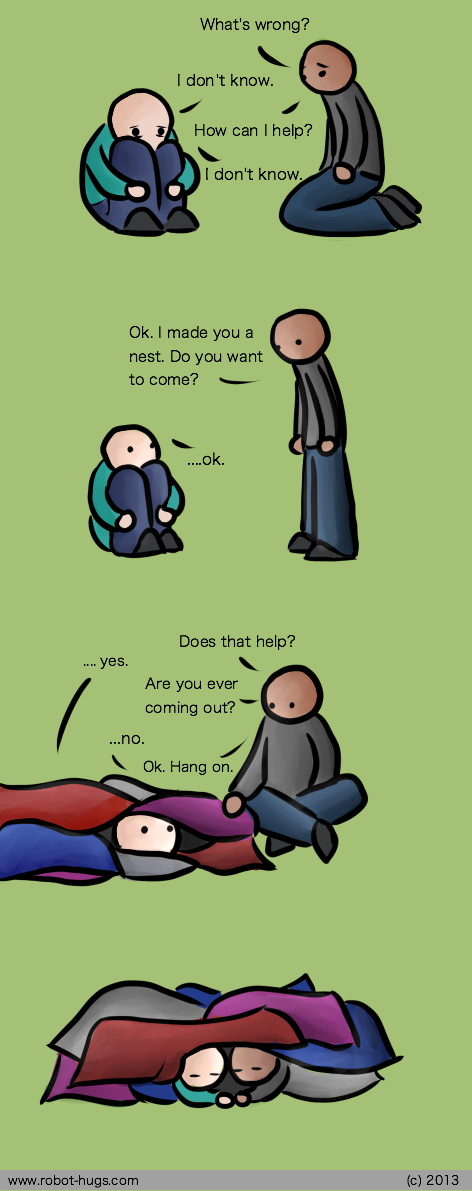
Robot Hugs blanket nest

It was 8:30 p.m., my husband and I were lounging on the sofa, catching up with our DVR, when my cellphone dinged. We have a rule that we try not to use our phones after a certain hour, unless we’re expecting news. If it had been one text, I would have ignored it. But it was the urgency of multiple incoming texts that made me break our rule.

It was my best friend. She had just found out that an acquaintance of hers had committed suicide (I didn’t know the person). She didn’t know her that well, they had only performed together once. Her friend, who had known the woman more intimately, had told her the news and he was devastated. My friend was in the middle of a rehearsal and couldn’t really talk, but she needed to tell someone who would understand. Who could offer advice on how to console her friend.

Despite being the bastion of mental health knowledge that I am, I was at a loss and caught completely off guard by her text. There’s no real way to prepare for the news of a suicide. Other than being there for them, listening to them, and giving them a hug if they want it, there’s no real way to console a friend or family member who is dealing with this type of loss.

The absurd thing about this situation is that in the past two months, this is the third suicide victim I have heard of (and I’m not counting the multiple suicides covered by the media, like Leelah Alcorn). I haven’t personally known any of the victims. It’s always a friend of a friend, but the news always hits me like a punch in the stomach, knocking the wind out of me before I am brought to tears. (I cry for the death of strangers because I feel a fellowship with people who have mental health issues and because I know that black hole of sadness all too well.)

Except Wednesday night, something was different. Maybe it was because it was my best friend who was distraught over this sudden news, or maybe it was because this was the third person, but I was fucking angry.

I was pissed off that someone was struggling so badly that they felt the need to take their life. I was fucking pissed that they were so desperate that death seemed like a better alternative than living. I was fucking pissed that they were clearly not getting the help they needed or deserved. I was fucking pissed that people would say how they never “saw it coming.” I was fucking pissed off because suicide shouldn’t happen, but it seemed to keep happening over and over again.

Suicide warning signs

Despite all the advances we have made in mental health awareness, suicide is still an issue that is shrouded in silence and secrecy. Suicide is treated like a “contagious” disease, as if you can catch it just by speaking its name. Maybe “suicide contagion” happens not because of the act itself, but because no one wants to talk about it. No one wants to talk about the fact that maybe they’ve thought about killing themselves before because it’s embarrassing and morbid. Or maybe they had a relative who committed suicide that no one talks about. Or maybe suicide just makes them feel terribly sad, even if they didn’t know the person.

There’s no easy way of talking about suicide because it’s hard to explain why someone would think killing themselves is a viable solution to their problems. As someone who has seriously thought about numerous ways to die, suicide is still hard to articulate. It’s a complex and confusing issue because it goes against one of our most basic instincts, self-preservation.

The thing is, suicide is never about wanting to die, it’s about wanting the pain to end. It’s about wanting to disappear. It’s about wanting whatever it is you’re struggling with to be over. If you’ve never battled with depression, anxiety, post traumatic stress disorder, an eating disorder, or any other form of mental illness it’s hard to understand the enduring and seemingly never ending psychic pain. It’s a pain that follows you like a shadow in your waking hours and haunts your dreams as you sleep. There is no escaping it.

Moreover, suicide is hard to talk about because of the pervading myths that surround suicide. I’m sure a researcher somewhere has done a fancy study with numbers, but I’ve been in enough social situations to know how dumb people can be about mental health and suicide.

I was at a party this past summer when the subject of suicide, self-harm, and mental health came up. I don’t know how or when the conversation started, but it was sudden and swift and I braced myself for impact.

“They say it’s a cry for help.”

“They do it for attention.”

“Well they say that you can tell a cutter from someone who really wants to die by the direction of the cuts.”

“How much of a loser do you have to be to fuck up your own suicide?” 

“I get why people jump in front of a metro – but everyone knows taking a bottle of Advil will only make you sick.”

These comments were tossed out over wine and cheese, in front of near perfect strangers. This is the stupidity and callousness with which suicide is discussed. It was complete thoughtlessness and ignorance that dominated the conversation.

Condescending Wonka

Don’t be a douche waffle when you talk about mental health & suicide

Let me demystify a few things about cutting and suicide – the two are not intrinsically linked. Just because you cut, doesn’t mean you want to commit suicide. Attempting suicide or self-harm are not cries for help and aren’t attention seeking behaviours. People who do these things are sick, just like someone who has cancer or diabetes, and they simply don’t know how to cope with their feelings or the world they’re living in. (The Canadian Mental Health Association has broken down more myths about suicide).

This is what I wished I had said at this party. But after bearing the weight of these words in silence, I made a quick exit in tears.

So it’s not that we shouldn’t talk about suicide because we’re afraid it’ll be contagious, but we need to know HOW to talk about it. We need to be SENSITIVE to our audience. We need to be CONSIDERATE of other people’s experiences. We need to be KIND and UNDERSTANDING.

Suicide isn’t an easy subject to broach and defies all logic, but we need to talk about it or else all of these deaths will have been in vain.

If you or someone you know is thinking about suicide know that there is hope. Here are contact numbers for organizations that help people in crisis.

Canada: 1-800-SUICIDE OR help lines and centers by province OR 911

US: 1-800-273-TALK

US LGBTQ Youth (the Trevor Project): 1-866-488-7386

US Veterans Crisis Line: 1-800-273-8255 (press 1)

InternationalBefrienders Worldwide

Australia:  13-11-14 (lifeline) or 1-800-55-1800 (kids help line for 5-25 yrs old)

Are you better yet? The long road of mental health recovery

Are you better yet?

No one has actually asked me this question because my friends and family are more considerate than that, but I know it’s a question that’s itching in their minds and if they weren’t sensitive to my illness they may actually ask it. I’m extremely lucky to have colleagues who have become good friends and despite my absence from work, we still manage to get together once in a while. When I met with them last week, they asked about my health in a kind and unobtrusive way. They asked how I was feeling, never asking when I would return to work. Still, I felt like the question of, “are you better yet?”, was hanging in the air, just waiting to be given voice.

DSC01266_edited-1_thumb[15]Or maybe it’s all in my head. Maybe I only think other people want to ask that question  because I’m wondering, am I better yet? Could I return to work? And what happens when I eventually do return? Will I be treated any differently than before? Will I be perceived as broken and damaged, or worse, weak?

Despite being absent from work for three months, I’m still feeling embarrassed and guilty that I had to take time off to tend to my mental health. I know I shouldn’t feel this way because it’s just as legitimate as taking a leave because you are physically sick. But reality doesn’t  change the way I feel.

When I met with my friends/colleagues (frolleagues?) I found out that my favourite project has been passed off to someone else. I assume it’s because I’m not there to take care of it, and that is disappointing, but also understandable. It’s a massive undertaking and requires a lot of planning that I’m not there to do. There’s always next year, I guess.

This is the reality of having a mental illness. The world doesn’t, and can’t, stop just because your brain breaks. It doesn’t matter if you’re hospitalized, catatonic with depression, or losing touch with reality because of mania; the world keeps moving without you and I think that’s the hardest part for me to come to grips with. It irks me knowing that someone else is working on this project and that if I could have survived just a little longer it could be me working on it.  Or if I could have just returned to work already, maybe they would have held out a little longer before replacing me. But it’s this type of thinking that got me into this mess in the first place.

Mental healthy recovery is a long journey.

Mental healthy recovery is a long journey.

Of course, I already had the existing condition of bipolar disorder, but it was my inability to disengage with work, share the load, and ask for help when I was floundering that pushed me over the edge. I wanted (and still want) to please everyone and show them (and myself) that I’m strong enough to do it all, despite my mental illness. Except even those without mental health issues can’t do it all without eventually breaking.

Also, if I’m 100 per cent honest with myself I know I couldn’t return to work full-time tomorrow. My body is still getting used to a new medication regimen, which means my moods are still up and down. I still struggle with simple tasks and become easily overwhelmed (writing this blog has been a chore rather than something I enjoy). I cry very easily and can’t manage stress. I wouldn’t last a week at work before I was back at square one, or worse. Now that I have three months distance from where I started, I can recognize that I was skating on thin ice for a long time. As I persevered through the stress, taking on more and more projects, the ice was cracking beneath me as I skated along, pretending that nothing was wrong. I was just lucky that I caught myself before the ice broke and I ended up in the hospital.

So, I guess if anyone is wondering if I’m better yet – no, not yet. But I’m getting there.

No pill can cure mental health stigma

Recently at a concert at the O2 arena in London, Lady Gaga confessed to her fans that she takes antidepressants for depression: “I take medication every day for mental illness and depression and [I] don’t feel bad about it.” She then went on to serenade her fans with a rendition of her hit song “Born this Way.”

Why would she feel bad for taking an antidepressant? Stigma.

antidepressants

Up to 9% of Canadians take some form of antidepressants.

But how can stigma exist in Canada when Canadians are among the highest antidepressant users in the world: “with as much as 9 per cent of the population on one depression-fighting drug or another, according to a new study from the OECD.”

If 9 per cent doesn’t strike you as a lot, do the math. The Canadian population was last estimated at roughly 35 million. That’s over 3 million Canadians taking some form of psychopharmaceutical. That’s a heck of a lot of people.

Stigma about medication and mental health exists because no one talks candidly about it. It’s great that public figures like Lady Gaga are talking more and more openly about mental health, but it’s not enough. Confessing you take medication for depression is only step-one in combating stigma. The rest is talking about the nuances of what taking medication is actually like. Demystifying the belief that it’s a magic pill (it isn’t) or that antidepressants are exclusively bad (they aren’t).

Over the course of the past 10 years, I think I have taken more pharmaceuticals than the average person will take in their lifetime. I play a weird memory game with myself and I try and run through all of the prescriptions that I have filled over the years. The names of SSRIs, SNRIs, and antipsychotics have become like a mantra: Zyprexa, Ativan, Effexor, Lithium, Wellbutrin, Risperdal, Seroquel, Clonazepam, Zoloft, and Celexa.

But it hasn’t always been this easy to confess that I have taken and am taking these medications. It took me over 10 years of silent suffering to admit that I have a mental illness and that I depend on medication to function. I’ve started openly talking to friends and family about how medication makes me feel, how it intrudes on my life, how it messes with my memory and recall, and despite knowing that it manages my mood that it’s a struggle to swallow that little pill every morning and night.

protect-your-nutsTo be honest, I’m embarrassed that I probably take more medication than my 80 year-old grandmother. When we have company over, I’m like a squirrel, stashing my pill bottles like nuts to keep them away from prying eyes. I spend five minutes every Sunday filling my pill dispenser that I refer to as my “pill hotel.” No one knows that I need to remember to take my medication with me if I go out. I worry about taking my pills on time. If I take a certain pill too late, I’ll never wake up the next day. If I forget a dose, I have the symptoms of a heroine addict going through withdrawal. I don’t tell people about how I worry about going through customs with all of my pill bottles in my carry-on, lest I become like this lady. My medication causes my memory to really suck. And at this very moment I’m struggling with forming sentences and articulating words.

But it’s not just these weird idiosyncratic life interruptions of taking medication. I often worry about the toll these pills are taking on the organs processing them. They all pass through the liver which is terrifying. Not only that, but most antidepressants and antipsychotics also wreak havoc on your metabolism and interfere with certain chemical receptors in your brain that cause weight gain. So, I’m about 30 pounds heavier than when I started taking psychopharmaceuticals and that’s something I’ve had to learn how to cope with. It sounds like an okay trade off — being heavier and alive versus depressed and suicidal — and I agree. But with depression comes an inherent lack of self-esteem, so it’s hard facing the mirror. And if all of that isn’t enough, one of the medications I take also negatively impacts cholesterol. So at 28, I’m worrying about cholesterol levels and have my blood taken regularly. There’s also the odd side effect of excessive sweating. Some people are lucky and it only happens at night but others are not (embarrassingly, I’m in the “are not” category). And let’s not even get into what happens if I choose to become pregnant… that issue is its own blog post.

So if it’s so shitty taking these medications, why do over 3 million of us decide to take them? Tell me what the alternative is. Therapy! Of course there’s therapy, but those in crisis (e.g. suicidal or psychotic) know that expressing how we’re feeling is basically impossible. So even if there are studies that show that antidepressants may do more harm than good and that they don’t work, if you’re in crisis and feel like ending your life, the ability to take a pill that might stop your brain from turning against itself is sometimes enough to keep you holding on.

If physical diseases were treated like mental illness - ImgurIf you are among the lucky population who does react well to medication, taking a pill may allow you to work through the problems you’re facing in therapy and hopefully you won’t have to be on medication for the rest of your life. But the reality is that for some of us suffering from chronic mental illness, therapy isn’t enough. With Bipolar Disorder, I don’t think a form of therapy exists that would allow me to manage my mood better than taking Seroquel and that’s a reality I’ve started to come to terms with. I console myself with the fact that Seroquel is a better alternative to Lithium (for me).

Living with a mental illness, whether it’s depression, anxiety, bipolar disorder, or schizophrenia, is always a balancing act. You have to balance out what’s worse, the symptoms of your illness or the side effects of the medication, and it isn’t always easy to decide. Some people decide not taking medication is the way to go, but many people decide pills are a good way to deal with their illness. Whatever your decision, never let anyone tell you that you’re weak for having a mental illness or that taking a pill is the easy way out. We’d never say this to a diabetic taking insulin or a cancer patient going through chemo. Whatever you’re facing, you’re a mental health warrior on an incredibly difficult journey that is often filled with more downs than ups.

So I urge my fellow mental health advocates to continue talking candidly about what life is really like for those of us taking medication and living with our illness. At the end of the day, it’s all about ending stigma and unfortunately there’s no pill for that.

A version of this originally appeared on Healthy Minds Canada. It was also published by Huffpost Living Canada.

What is Bipolar Disorder II?

I was diagnosed with Bipolar Disorder II when I was twenty. Bipolar Disorder, also known as manic depression, is categorized as a mood disorder. The official definition from the Diagnostic and Statistical Manual of Mental Disorders (DSM IV) is that: “Bipolar II Disorder is characterized by one or more Major Depressive Episodes accompanied by at least one Hypomanic Episode,” (318). Essentially, the illness is composed of two main parts – hypomania and depression – ups and downs. But this doesn’t explain how the illness will interfere with a person’s life or what it’s actually like to be hypomanic or depressed.

Hypomania: It’s not just feeling happy 

Hyperbole and a Half

Original image from the blog Hyperbole and a Half by Allie Brosh.

Hypomania isn’t just about being happy – it’s excessive happiness. It can seem normal to people who don’t really know you, but for those who do they can distinguish between hypomania and happiness. When I’m hypomanic I feel more more creative, thoughts flow more freely and words come easily. I’m talkative, bubbly, and funny. I’m also extremely productive. I don’t know if I’m unique in my ability to funnel my hypomanic energy into productivity, but when I’m hypomanic I say yes to everything and overextend myself, which I don’t realize until later.

During my fall semester of grad school, I had a hypomanic episode and it was amazing what I accomplished in the same 24-hour period as my peers. I was weeks ahead in my readings. When they were stressed about term papers, I was writing PhD and grant applications because my papers were already done. I remember a professor asking me, “When do you sleep?” and I happily responded, “I don’t!” She thought it was a joke, I was dead serious.

I would be lying if I said I don’t enjoy being hypomanic. Depressive episodes are more common in Bipolar II, so for a short time hypomania feels like a relief; a breath of cool air on a muggy day. Except I don’t want to misrepresent hypomania because there is only so long you can function with minimal sleep before reality starts to slip away. The energy that was productive turns into anxiety and panic, which makes me irritable and hostile. I start thinking the world is out to get me. Those thoughts and words that were flowing transform from a steady stream into a pounding rush. My sentences come out in a frantic string and it’s like the dam between my brain and mouth breaks and I say all of those things that I would normally only think.

During the grad school episode I erupted on an unsuspecting librarian. The library had cancelled a book I had requested via interlibrary loan because they thought I had ordered the same book twice. The person who cancelled the request hadn’t noticed that it was two separate volumes. In a non-hypomanic state, I would have simply been frustrated, but in a hypomanic state this was akin to treachery. These volumes are the crux of my argument! I will fail because of your ineptitude! How hard is it to be a librarian? I’m a grad student goddammit! I was absolutely indignant. I may have even called the poor woman an idiot.

This isn’t my usual behaviour – my non-hypomanic self avoids confrontation and I would never belittle someone. But that’s the thing about hypomania, it transform you into someone else. These outbursts during hypomania can often make relationships very difficult and a lot of people lose their jobs.

Depression: It Sucks

The flip side of hypomania is depression. Unlike hypomania which is enjoyable (to a point), there is nothing remotely likeable or fun about being depressed. Depression isn’t just sadness. Depression isn’t an emotion. Depression is a heaviness in your brain and body. Depression is like trying to tread water with 100 pound weights tied to your ankles and as you’re struggling to keep your head above water, the voice of your elementary school bully is on a loop in your head urging you to stop trying and just drown already. You’d be better off dead anyway. It’s like your mind turns against you.

Toni Frissel, Weeki Wachee, Spring 1947

Toni Frissel, Weeki Wachee, Spring 1947

For the most part, I’m a functioning depressive. I’m still able to manage the day-to-day tasks that need to happen, but that’s it. Simple tasks, like showering or getting out of bed, are a struggle and exhausting.  After a day of work, all I can do is curl up on the couch in the fetal position and cry. I hate everyone and everything. But the thing I hate the most is myself.

Following my hypomanic episode during grad school, the depression set in hard by the end of the Spring semester. My 45 minute commute was filled with sobbing. I remember giving a presentation and bursting into tears in the middle of it. All I could think while giving the presentation was how stupid everyone must think I am. Clearly I’m an idiot and should just give up. There was no rationale for any of these thoughts. By the end of the semester the crying had stopped and the numbness set in – the scariest part of depression. I started to self-harm, something that I hadn’t done in a number of years and all I could think about was dying.  It wasn’t that I actually wanted to die, I just wanted to disappear. I would sit at my computer screen, trying to write my thesis, and just stare at the cursor blinking at me unable to string a sentence together. Eventually my partner noticed the cuts and forced me into the hospital.

Bipolar Disorder is a chronic illness that can’t be cured, it just goes into remission. I have been stable for the past 4 years due to the right concoction of medication and learning to recognize and accept my limitations (for the most part – I still struggle with saying no and overextending myself). It can be frustrating navigating my life around my illness, but I know what the alternative is and it’s really not an option. Unless my meds stop working and I come out of remission, I’m going to be as healthy and happy as I can be. But the most important thing I have learned is asking for help. No one should have to struggle alone.

This post originally appeared on Healthy Minds Canada.

My Bipolar Journey

Some people’s depression is triggered by an event, a major loss or a tragedy. My first depressive episode had no inciting incident. It happened slowly and all at once. The sadness and dread was overwhelming. I couldn’t stop crying. I stopped going out. I stopped talking to my roommates. I hated everything and everyone. I skipped classes. I stopped eating. I thought about suicide and I started cutting.

For me, the scariest part of depression is when the tears stop and the numbness sets in. You start to wonder if you’ll ever feel anything again or if you’re doomed to walk through the rest of your life like a zombie. It was when the numbness had enveloped me that I cut for the first time.

I’ve been asked by my partner, my parents, and psychiatrists: At what point did I make the decision to cut myself? And honestly, I have no idea. I barely remember making that first cut, let alone the decision-making process that went into it. What I do remember is watching the blood pool to the surface and feeling relief as I felt the burning pain of the cut. I could feel physical pain. And so I made another, and another, just to remind myself what feeling was like.

The idea of self-harm goes against every rational thought and evolutionary cue humans have. We are genetically coded for self-preservation. But, then again, depression isn’t rational. It was over a week later, after accidentally rolling up my sleeves, that my roommate saw the multiple cuts along my arms, in various stages of healing.

Shocked and terrified by what I had done to myself and what I might do next, she begged me to let her call emergency services. Even depressed, I am stubborn, so I refused over and over again. Finally, we compromised and she dragged me to the university’s health services the next day. Then she did the one thing I never thought she would do, the ultimate betrayal: She called my parents.

It was months later that I realized that she had probably saved my life. To this day, despite distance and time rendering our friendship to an occasional Facebook post, I am incredibly thankful for her bravery and courage.

Because you can't be depressed with a bounding kitten! (Well you can, and that's okay.)

Because you can’t be depressed with a bounding kitten! (Well you can, and that’s okay.)

I’d like to tell you that this was the end of my mental health story. That I never experienced depression again, that I never cut again, and that I never thought about killing myself. Unfortunately, this was only the beginning of an ongoing struggle. Mental illness is insidious. It’s a monster that buries itself deep in your brain and rears its ugly head when you least expect it. And just when you think you’ve gotten to know the game it plays, the rules change.

After my first depressive episode, I enrolled in a university closer to home so I could live with my parents and have a stronger support system in the event that the monster returned. I started to excel in school again and reconnected with old friends. Life was good. It was a year before I experienced what I would later find out was my first hypomanic episode. A game changer.

The hypomania started with a simple idea: I was going to redecorate my bedroom. I bought the paint, moved all the furniture out of my room, and repainted. I moved like I was on speed and spoke faster than anyone could understand or follow. Then the anxiety started. I became agitated, volatile, and angry. Then I couldn’t sleep. My mind raced through all of these amazing ideas that I couldn’t keep track of.

Then I crashed.

In the span of a day, I went from hyperproductive to the languid darkness of depression. I couldn’t understand it. I took my meds religiously and maintained monthly appointments with my psychiatrist. It turns out he had misdiagnosed me. When I first saw him, I was only displaying symptoms of depression and so, logically, he prescribed me antidepressants. Those pills I had been taking regularly had caused the hypomania. Apparently, I didn’t suffer from depression and anxiety, like he originally thought. I actually had an illness that was much more difficult to spot: bipolar disorder type II. I left his office that day with a prescription for Lithium and orders to reduce the dosage of my antidepressants.

Lithium is horrible. It made food taste like metal, it made me nauseous and dizzy, and it required monthly blood tests. But it did level out my mood quickly, and the depression didn’t last as long. Unfortunately, there’s no cure for bipolar disorder — it’s a chronic illness. Meds can stop working, life can get too stressful, and suddenly the cycle starts again. I perpetually feel like I’m waiting for the other shoe to drop.

In total I have been through three hospitalizations. I’ve seen more psychiatrists and psychologists than I can count. I’ve taken anti-depressants, sleeping pills, anti-anxiety medication, anti-psychotics and anti-convulsants. I’ve gone through in-patient and out-patient treatment. I’ve hurt myself physically, I’ve hurt others emotionally, and I’ve thought about suicide way too often.

Bipolar disorder may be a chronic illness, but I’m no less capable than someone without it. I’m not deranged or dangerous. I just have to navigate my life a little differently, and despite my struggle with my illness, wonderful things have also happened in my life. I completed two university degrees. I travelled to several countries. I got married. I wrote a first draft of a novel. I moved provinces. I got a job I like and that I excel in. I’ve made great friends. I became a mental health advocate. And this year, I have started to share my story.

I have spent the last decade of my life hiding my illness because I have feared judgement. I have been afraid of losing friends, of being unemployable, of being an embarrassment, and of appearing weak. This year, with my work in the mental health community, I have been inspired by the courageous individuals who shared their stories of self-harm, hospitalizations, suicide attempts, relapse, and triumph.

Well, now it’s my turn. I’m adding my voice and story into the mix and maybe, if I’m lucky enough, I’ll inspire someone as much as these people have inspired me.

This was originally posted on Stigma Fighters and The Huffington Post’s Stronger Together.