Retreat not defeat: Self-Stigma and Mental Health

I have been stable for the past four years, but now my bipolar disorder has resurfaced. It could have been triggered by stress, meds or the weather change — or equal parts of all of these things — but the reality is that I’m unwell.

Demi Lovato can rock it, why can't I?

Demi Lovato can rock it, why can’t I?

Saturday highlighted this, as I was in a full hypomanic episode. Upon reflection, it had been building all week but I didn’t realize it. I had been having extreme anxiety all week and had been very agitated. I wasn’t sleeping and I was extremely volatile. By Saturday, this agitation and anxiety had turned into excessive, delirious energy that despite working out for two hours, taking anti-anxiety meds, and trying to take a calming bath, it wouldn’t go away. My speech was rapid and bouncing from one thought to the next. I couldn’t sit still. I was moving like I was on speed. I had great ideas (I saw a girl with half of her head shaved and thought that would be an awesome look for me, too. And while it might be an awesome look for me, it’s not a decision to be made while hypomanic).

It was when I said this that my husband asked if I was hypomanic. Calmly, he described my behavior and I trust his judgement enough to know that if this is what he is seeing, it’s true.

I’m equal parts frustrated, disappointed and defeated. It has been so long since my mood swings have been so volatile and explosive. It has been a long time since I felt manic. It has been a long time since I have felt so completely out of control.

Under the suggestion of my doctor and psychiatrist, I have taken a leave of absence from work. To be honest, this has been the hardest thing I have had to do in my life. I feel like I have admitted defeat to my illness. I feel like my leave of absence is showing the world that my illness makes me weak and that I can’t hack it in the real world.

Rationally, I know this is totally unsubstantiated. I have a supportive partner, family, and friends. I have previously disclosed my illness to my boss in preparation of writing this blog and she had demonstrated my illness didn’t taint her view of me. But there’s nothing I love more than feeling guilty, so I still beat myself up.

stigma

What about self-imposed stigma?

I try to situate my mental illness like someone who has cancer. If a colleague took a leave to get chemotherapy, would I judge them? Of course not. I would probably send them an email wishing them well or send flowers to their hospital room. But we don’t think of mental illness in this way because it’s symptoms are not visible. My moods are visible — I’m agitated, I’m teary, I don’t sleep — but the “proof” that the actual illness exists isn’t visible. It’s my word and a doctor’s signature on some paperwork.

We often speak of stigma in terms of external judgement — how others perceive those with mental illness. But a form of stigma we don’t often talk about is the self-imposed stigma. Will I get fired for taking a leave of absence? Will I be given less interesting projects because they’re less stressful? Will they think I’m less capable because of my illness? Do my colleagues think I’m lazy and just don’t want to work? Are people whispering about the crazy girl who had a breakdown? I am so consumed by thoughts about what other people might be thinking about me, I neglect what’s most important — what I think and need.

Last week, these self-imposed judgments were spinning in my head increasing my agitation and anxiety. In an attempt to help, my husband and I set out on a walk of undetermined length. As we walked, I explained all of these thoughts to him.

If I look back, I am lost

“If I look back, I am lost,” Danaerys Targaryen. A Song of Ice and Fire by George R. R. Martin.

“I’m regretting taking this leave of absence. Maybe I could take back the paperwork that had been submitted. I could go to work and have my medication readjusted — I could handle that. I didn’t really need this leave of absence at all. But on the other hand I’m so tired and angry — what if I blow up at work? I already snapped at one co-worker when I normally wouldn’t. I could lose my job. Also, I was sobbing at my desk on Tuesday. That’s not right. No, I do need this leave. It’s good for me. But on the other hand…”

After listening patiently to my rambling and often contradictory thoughts for the better part of an hour, he finally said something:

“I know deep down you know that this is the right decision. In the 10 years we have been together, this is the first time I have seen you choose yourself over other people. I’m proud of you.”

This stopped the self-stigma in its tracks. He reminded me that this leave is only a minor setback. I haven’t surrendered to my illness, I’ve just retreated. No general would continue when the battle is surely lost. A general would regroup, tend to the wounded, gather reinforcements, and re-strategize. And that’s all I’m doing. I may have lost this battle, but there’s still a war to win.

A version of this post originally appeared on Healthy Minds Canada and The Huffington Post’s Stronger Together.

My battle with depression and anxiety

If a shoe is going to drop, please let it be a Louboutin.

If a shoe is going to drop, please let it be a Louboutin.

Living with a chronic mental illness often feels like waiting for the other shoe to drop. Well, the proverbial shoe has dropped (it’s stylish at least). I’ve been struggling for a while, but I’m finally coming around to admitting it. Despite seeing therapists on and off for nearly 10 years, I still find it hard to communicate how I feel. But even more difficult is being honest with myself about how I am feeling. So I guess this is sort of a litmus test. Will confessing how I feel get me out of denial or will I continue to keep my head in the sand and ignore it?

I’ve been battling semi-regular panic attacks for the past six months. My first panic attack in years happened in March. As with most panic attacks, they happen at the most inopportune moments. This particular one happened during the middle of a concert. I was at a bar that was packed with drunk hipsters, tossing their bodies carelessly to the music. I began to feel claustrophobic among the ever-increasing press. The bass of the music reverberated in my chest, amplifying my pounding heart. The bar was too hot. The walls were closing in on me. I couldn’t catch my breath. My heart felt like it was going to explode out of my chest. I had to get out of there. My husband and I snaked our way through the crowded bar, each time someone bumped into me, a jolt of adrenaline coursed through me like an electric current. By the time we made it to the door, I was in the throes of a full-blown panic attack.

i-can-t-keep-calm-because-i-have-anxiety-28These situations are incredibly frustrating. As I was leaning against the building, among the smokers and couples making out, I couldn’t help but cry. I was having such a great evening before this. My husband and I enjoyed an incredible dinner before the concert. We were hanging out with friends, listening to an amazing band. And then I had to leave before they finished their set. Compounding my anxiety was the fact that the friends I was with had no idea what was happening. As we left, I mumbled excuses about having to catch the last metro.

Panic attacks are like getting the stomach flu right before an event. Except instead of knowing before that you were cancelling to puke in the safety of your home, you’re suddenly vomiting in public (lovely imagery, I know) and rushing out of the door.

After this first attack, I started seeing a therapist (who was a former psychiatrist) for the first time in about four years. She’s an incredibly lovely lady. She suggested that I exercise more and cut out caffeine and sugar. I started working out every day, reduced my caffeine (I haven’t had a coffee that wasn’t decaf in three months) and tried to avoid sugar as much as humanly possible. Except, none of this helped and the panic just got worse.

As my anxiety levels increased to nearly intolerable levels, sleep became a joke (despite already taking medication that is supposed to help me sleep). I can’t tell you the last time I have slept through the night. Finally in May, after not sleeping for about four days, I was given anti-anxiety medication. I often pair my nighttime pill with my anti-anxiety meds, but I still wake up in semi-terror, feeling like I have forgotten something important. Other nights I just toss and turn unable to sleep at all.

But lately, it’s more than panic plaguing me. An encompassing sadness has attached itself to me like a shadow — following me wherever I go, no matter what I do. I’ve had this feeling before, it’s certainly not new to me. It’s just been a while. I know it’s depression waiting in the wings. I know that if I don’t fight it hard enough, it will envelope me completely. So everyday I force myself out of bed and go to work. I force myself to keep plans and socialize because I know that if I don’t, I’d spend my weekends in bed, reading or watching TV until Monday. I know that depression is never fought by being a hermit. Sometimes it works and I end up enjoying myself out with friends but other times, I just wish I was in bed.

cd4304cad520eceb4f3f9df23225ad46Nothing comes easily right now — including writing this. Stringing words together has always come easily to me and it’s frustrating to feel like there’s a dam blocking my flow of words (perhaps that’s why I resorted to a scatalogical simile earlier).

But the worst part of all of this is watching the concern on my husband’s face. I know as I stare silently into space as we watch TV, his mind is running through worst case scenarios. Is she thinking about killing herself? Is this going to result in another hospital stay? Will I catch her self-harming? How concerned do I need to be?

You may be thinking that these scenarios may seem a bit extreme, but the fact is that we’ve gone through all of them, and only four short years ago. My parents have been extremely supportive through the ups and downs of my illness, but they don’t have a choice — I’m their kid. My husband always had the option to leave and he didn’t — even when I have repeatedly encouraged him to.

Even if his worst case scenarios have happened in the past, the reality of this recent sadness (I am still reticent to name it depression, for now) is that I’m not in that headspace. I refuse to resort to self-harm at 28 years old. I’m not thinking of suicide as a viable option because I see the value of my life. And for the first time in my illness, I’m actually taking positive steps to help stave off depression.

The first step was recognizing the persisting sadness — it’s been longer than a week, this is more than a bad mood. The second step was making an appointment with my therapist. And the third, and probably the most important step, was sharing how I was feeling with my husband and parents (my main support system). This third step has always given me the most trouble.

It’s not that these steps will guarantee that I will ward off a full blown depressive episode. I’m terrified that it could still happen. I’m intimidated by the thought of changing my medications and dealing with new side effects. I’m scared that I might have to take a leave from my job. I’m horrified by the potential of another hospital stay.

But at the end of the day, even if all of this happens, at least I know I tried. And that’s something.

A version of this piece originally appeared on Healthy Minds Canada. It was also published on The Huffington Post’s Stronger Together.
Memoirs taught me more about my mental illness than doctors did

Since I started to share my mental health story with the public, people keep telling me that I’m brave. As flattering as that is, I don’t think I’m particularly brave because many before me, and many after me, will share stories that are more compelling, filled with more struggle and told much more eloquently than my own. But the reason I chose to start sharing my story is because I found strength in other people’s; they became a life raft that I clung to when I was in a bad spot, couldn’t figure out what was happening to me or just needed to feel like someone understood where I was coming from.

The doctor is in

The doctor is in

When I was first diagnosed with bipolar disorder, I had never heard of the illness and knew nothing about it. The psychiatrist explained it vaguely as having peaks and valleys in your moods that aren’t “typical.” He briefly described hypomania and depression, both of which I had already experienced, but he gave me no insight into how to manage these peaks and valleys or how my life could or would be forever impacted by this diagnosis. I left his office with a script for Lithium, another appointment to see if I had levelled out and a list of unanswered questions.

You’re probably saying to yourself, well maybe he was just a bad psychiatrist — and you’d be right. But frankly, I’ve never met a good one. To me, a good psychiatrist is sort of like Bigfoot or a UFO. People say they exist and have told me of their encounters with them, but I’ve still never seen one with my own eyes.

Psychiatrists have repeatedly discredited my lived-experience with depression, anxiety and bipolar disorder. One psychiatrist told me that I wasn’t really depressed because “real” depressed people didn’t shower or get out of bed. Another said that I was too calm to be experiencing panic attacks (oh, maybe I’ll just come in when I’m in the throes of a panic attack — would that prove that I’m having one?) And then there was the truly awful, which only happened about two years ago. He patronized me about pregnancy while on medication, despite my assurances that pregnancy wasn’t in the cards for a number of years. He also inferred that I shouldn’t actually have children because they could “get what I have.” (Didn’t you know that having a mental illness makes you a horrible monster who should be hidden from the world and we should be forced to become sterile? He would have fit in perfectly with the Victorian-era doctors).

So now, looking back on my psychiatrist’s lack of explanation, I’m not shocked about his unhelpfulness. But that day, I left his office completely baffled. So, like anything I don’t understand, I started to read about bipolar disorder. I armed myself with The Diagnostic and Statistical Manual of Mental Disorders (DSM). I started with the incomprehensible definition of bipolar disorder in the DSM, written in jargon by doctors for doctors. Unsatisfied with that I started to read psychology articles that explained how important sleep and exercise was or how eating a healthy diet was integral to managing your mood. Everything that I read also talked about how stress could trigger a “mood episode.” Although none of this talked about how to avoid stress in your day-to-day life, or how to speak with your spouse about your feelings or what to do if you can’t sleep.

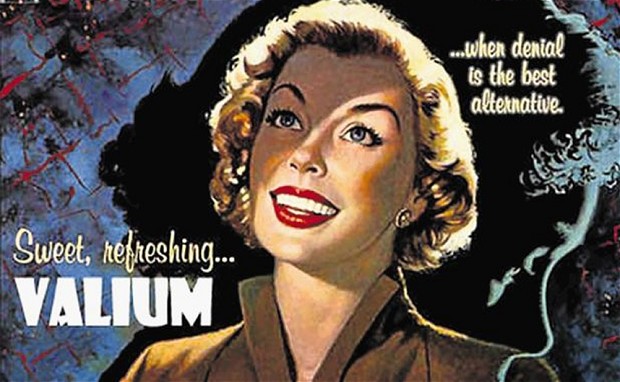
Mother's little helper

I also read about how psychopharmaceuticals were typically marketed to women. (Did you know Valium was referred to as “Mother’s little helper”?) and that the diagnostic categories in the DSM have a long history of being extremely gendered. (Did you know that the 19th-century diagnosis of hysteria, which was almost exclusively a female malady, actually comes from the Greek hysterikos for “suffering of the womb”?)

As interesting as all of this is, none of it helped me understand myself in relation to my illness. Nothing talked about what it was like to try endless medications and have none of them work for longer than two years. They didn’t talk about how Lithium made eating dairy products unbearable or how it made me incredibly dizzy all of the time. It didn’t talk about how taking Seroquel would affect how and when I go to sleep or how crappy it is to get blood tests every couple of weeks. Or how expensive medications are. They didn’t talk about what it’s actually like to be on a psych ward or how no one can possibly understand why you’d consider suicide as a viable option. None of what I read described what I was going through.

The best thing I ever did was to leave the academic texts behind and turn to memoirs written by people who live with mental illness. I don’t know what brought me to this place — maybe some vain hope that somewhere, someone else was experiencing what I was going through. And thankfully that’s exactly what I found.

The Loony Bin TripThese stories are told from the front lines of mental illness from a variety of perspectives; addressing gender, occupation, socioeconomics and race. The authors write candidly about suicide and self-harm, they detail the difficulties of maintaining relationships through the ups and downs of their illnesses, they explain uncomfortable side effects of psychopharmaceuticals (my memoir will be called: “May cause excessive sweating and weight gain”). They talk about the strange camaraderie that forms on a psych ward as you trade war stories of your worst panic attack, botched suicide attempts and which medication gave you the worst side effects.

These stories made me realize that It doesn’t really matter what the DSM or the psychology articles said about me, mental health and what I should be experiencing. What was important was my experience. That is the reality of the illness.

What these memoirs gave me that the academic articles never could was a sense of community. It didn’t matter that the authors had different experiences or diagnoses from my own because I could still see myself in them — they were still telling my story. They understood. Feeling understood, even if it’s by someone you’ve never met and will probably never meet, is sometimes enough to keep going when you’re feeling frustrated and fed-up with the system.

This is why sharing our stories about mental health is crucial. Our stories could save a life or at the very least give someone the hope to keep fighting.

Interested in reading some memoirs on mental health? Check out my Mad Books.

This post was originally published at Healthy Minds Canada. A version also appeared on The Huffington Post Canada Impact.

What is Bipolar Disorder II?

I was diagnosed with Bipolar Disorder II when I was twenty. Bipolar Disorder, also known as manic depression, is categorized as a mood disorder. The official definition from the Diagnostic and Statistical Manual of Mental Disorders (DSM IV) is that: “Bipolar II Disorder is characterized by one or more Major Depressive Episodes accompanied by at least one Hypomanic Episode,” (318). Essentially, the illness is composed of two main parts – hypomania and depression – ups and downs. But this doesn’t explain how the illness will interfere with a person’s life or what it’s actually like to be hypomanic or depressed.

Hypomania: It’s not just feeling happy 

Hyperbole and a Half

Original image from the blog Hyperbole and a Half by Allie Brosh.

Hypomania isn’t just about being happy – it’s excessive happiness. It can seem normal to people who don’t really know you, but for those who do they can distinguish between hypomania and happiness. When I’m hypomanic I feel more more creative, thoughts flow more freely and words come easily. I’m talkative, bubbly, and funny. I’m also extremely productive. I don’t know if I’m unique in my ability to funnel my hypomanic energy into productivity, but when I’m hypomanic I say yes to everything and overextend myself, which I don’t realize until later.

During my fall semester of grad school, I had a hypomanic episode and it was amazing what I accomplished in the same 24-hour period as my peers. I was weeks ahead in my readings. When they were stressed about term papers, I was writing PhD and grant applications because my papers were already done. I remember a professor asking me, “When do you sleep?” and I happily responded, “I don’t!” She thought it was a joke, I was dead serious.

I would be lying if I said I don’t enjoy being hypomanic. Depressive episodes are more common in Bipolar II, so for a short time hypomania feels like a relief; a breath of cool air on a muggy day. Except I don’t want to misrepresent hypomania because there is only so long you can function with minimal sleep before reality starts to slip away. The energy that was productive turns into anxiety and panic, which makes me irritable and hostile. I start thinking the world is out to get me. Those thoughts and words that were flowing transform from a steady stream into a pounding rush. My sentences come out in a frantic string and it’s like the dam between my brain and mouth breaks and I say all of those things that I would normally only think.

During the grad school episode I erupted on an unsuspecting librarian. The library had cancelled a book I had requested via interlibrary loan because they thought I had ordered the same book twice. The person who cancelled the request hadn’t noticed that it was two separate volumes. In a non-hypomanic state, I would have simply been frustrated, but in a hypomanic state this was akin to treachery. These volumes are the crux of my argument! I will fail because of your ineptitude! How hard is it to be a librarian? I’m a grad student goddammit! I was absolutely indignant. I may have even called the poor woman an idiot.

This isn’t my usual behaviour – my non-hypomanic self avoids confrontation and I would never belittle someone. But that’s the thing about hypomania, it transform you into someone else. These outbursts during hypomania can often make relationships very difficult and a lot of people lose their jobs.

Depression: It Sucks

The flip side of hypomania is depression. Unlike hypomania which is enjoyable (to a point), there is nothing remotely likeable or fun about being depressed. Depression isn’t just sadness. Depression isn’t an emotion. Depression is a heaviness in your brain and body. Depression is like trying to tread water with 100 pound weights tied to your ankles and as you’re struggling to keep your head above water, the voice of your elementary school bully is on a loop in your head urging you to stop trying and just drown already. You’d be better off dead anyway. It’s like your mind turns against you.

Toni Frissel, Weeki Wachee, Spring 1947

Toni Frissel, Weeki Wachee, Spring 1947

For the most part, I’m a functioning depressive. I’m still able to manage the day-to-day tasks that need to happen, but that’s it. Simple tasks, like showering or getting out of bed, are a struggle and exhausting.  After a day of work, all I can do is curl up on the couch in the fetal position and cry. I hate everyone and everything. But the thing I hate the most is myself.

Following my hypomanic episode during grad school, the depression set in hard by the end of the Spring semester. My 45 minute commute was filled with sobbing. I remember giving a presentation and bursting into tears in the middle of it. All I could think while giving the presentation was how stupid everyone must think I am. Clearly I’m an idiot and should just give up. There was no rationale for any of these thoughts. By the end of the semester the crying had stopped and the numbness set in – the scariest part of depression. I started to self-harm, something that I hadn’t done in a number of years and all I could think about was dying.  It wasn’t that I actually wanted to die, I just wanted to disappear. I would sit at my computer screen, trying to write my thesis, and just stare at the cursor blinking at me unable to string a sentence together. Eventually my partner noticed the cuts and forced me into the hospital.

Bipolar Disorder is a chronic illness that can’t be cured, it just goes into remission. I have been stable for the past 4 years due to the right concoction of medication and learning to recognize and accept my limitations (for the most part – I still struggle with saying no and overextending myself). It can be frustrating navigating my life around my illness, but I know what the alternative is and it’s really not an option. Unless my meds stop working and I come out of remission, I’m going to be as healthy and happy as I can be. But the most important thing I have learned is asking for help. No one should have to struggle alone.

This post originally appeared on Healthy Minds Canada.

My Bipolar Journey

Some people’s depression is triggered by an event, a major loss or a tragedy. My first depressive episode had no inciting incident. It happened slowly and all at once. The sadness and dread was overwhelming. I couldn’t stop crying. I stopped going out. I stopped talking to my roommates. I hated everything and everyone. I skipped classes. I stopped eating. I thought about suicide and I started cutting.

For me, the scariest part of depression is when the tears stop and the numbness sets in. You start to wonder if you’ll ever feel anything again or if you’re doomed to walk through the rest of your life like a zombie. It was when the numbness had enveloped me that I cut for the first time.

I’ve been asked by my partner, my parents, and psychiatrists: At what point did I make the decision to cut myself? And honestly, I have no idea. I barely remember making that first cut, let alone the decision-making process that went into it. What I do remember is watching the blood pool to the surface and feeling relief as I felt the burning pain of the cut. I could feel physical pain. And so I made another, and another, just to remind myself what feeling was like.

The idea of self-harm goes against every rational thought and evolutionary cue humans have. We are genetically coded for self-preservation. But, then again, depression isn’t rational. It was over a week later, after accidentally rolling up my sleeves, that my roommate saw the multiple cuts along my arms, in various stages of healing.

Shocked and terrified by what I had done to myself and what I might do next, she begged me to let her call emergency services. Even depressed, I am stubborn, so I refused over and over again. Finally, we compromised and she dragged me to the university’s health services the next day. Then she did the one thing I never thought she would do, the ultimate betrayal: She called my parents.

It was months later that I realized that she had probably saved my life. To this day, despite distance and time rendering our friendship to an occasional Facebook post, I am incredibly thankful for her bravery and courage.

Because you can't be depressed with a bounding kitten! (Well you can, and that's okay.)

Because you can’t be depressed with a bounding kitten! (Well you can, and that’s okay.)

I’d like to tell you that this was the end of my mental health story. That I never experienced depression again, that I never cut again, and that I never thought about killing myself. Unfortunately, this was only the beginning of an ongoing struggle. Mental illness is insidious. It’s a monster that buries itself deep in your brain and rears its ugly head when you least expect it. And just when you think you’ve gotten to know the game it plays, the rules change.

After my first depressive episode, I enrolled in a university closer to home so I could live with my parents and have a stronger support system in the event that the monster returned. I started to excel in school again and reconnected with old friends. Life was good. It was a year before I experienced what I would later find out was my first hypomanic episode. A game changer.

The hypomania started with a simple idea: I was going to redecorate my bedroom. I bought the paint, moved all the furniture out of my room, and repainted. I moved like I was on speed and spoke faster than anyone could understand or follow. Then the anxiety started. I became agitated, volatile, and angry. Then I couldn’t sleep. My mind raced through all of these amazing ideas that I couldn’t keep track of.

Then I crashed.

In the span of a day, I went from hyperproductive to the languid darkness of depression. I couldn’t understand it. I took my meds religiously and maintained monthly appointments with my psychiatrist. It turns out he had misdiagnosed me. When I first saw him, I was only displaying symptoms of depression and so, logically, he prescribed me antidepressants. Those pills I had been taking regularly had caused the hypomania. Apparently, I didn’t suffer from depression and anxiety, like he originally thought. I actually had an illness that was much more difficult to spot: bipolar disorder type II. I left his office that day with a prescription for Lithium and orders to reduce the dosage of my antidepressants.

Lithium is horrible. It made food taste like metal, it made me nauseous and dizzy, and it required monthly blood tests. But it did level out my mood quickly, and the depression didn’t last as long. Unfortunately, there’s no cure for bipolar disorder — it’s a chronic illness. Meds can stop working, life can get too stressful, and suddenly the cycle starts again. I perpetually feel like I’m waiting for the other shoe to drop.

In total I have been through three hospitalizations. I’ve seen more psychiatrists and psychologists than I can count. I’ve taken anti-depressants, sleeping pills, anti-anxiety medication, anti-psychotics and anti-convulsants. I’ve gone through in-patient and out-patient treatment. I’ve hurt myself physically, I’ve hurt others emotionally, and I’ve thought about suicide way too often.

Bipolar disorder may be a chronic illness, but I’m no less capable than someone without it. I’m not deranged or dangerous. I just have to navigate my life a little differently, and despite my struggle with my illness, wonderful things have also happened in my life. I completed two university degrees. I travelled to several countries. I got married. I wrote a first draft of a novel. I moved provinces. I got a job I like and that I excel in. I’ve made great friends. I became a mental health advocate. And this year, I have started to share my story.

I have spent the last decade of my life hiding my illness because I have feared judgement. I have been afraid of losing friends, of being unemployable, of being an embarrassment, and of appearing weak. This year, with my work in the mental health community, I have been inspired by the courageous individuals who shared their stories of self-harm, hospitalizations, suicide attempts, relapse, and triumph.

Well, now it’s my turn. I’m adding my voice and story into the mix and maybe, if I’m lucky enough, I’ll inspire someone as much as these people have inspired me.

This was originally posted on Stigma Fighters and The Huffington Post’s Stronger Together.