Hold on: Find your depression life preserver

It’s been a hell of a week. Despite all of the wonderful things happening around me: my Facebook Page has reached just over 300 likes, I’m going to be in a documentary about Clara’s Big Ride, I had a journalist from Elle Canada contact me about a post I wrote on self-harm, my depression was so bad that I thought I was going to have to admit myself into the hospital.

On Monday, I spent three hours sobbing in bed without any explanation. I woke up in the morning and I felt off kilter but I figured it was because I hadn’t had a full night’s sleep in over a week. I had been experiencing terrifying nightmares. Not just nightmares where you’re late for work or you show up to your presentation naked, but the kind of nightmares that make you question your brain. Nightmares where I was gang raped, nightmares where I watched my husband’s throat get slit before they did my own. These nightmares woke me up, panting and sweating and unable to go back to sleep. I was afraid to sleep because I was afraid of the nightmares that might happen.

It's Okay to CrySo Monday was day five of this sleeplessness and in hindsight I should have contacted my doctor earlier, but I thought it was just anxiety. By Monday afternoon I was in full blown crisis. My husband came home for lunch and he could read it on my body that I was in a bad way. He decided to stay home because he was afraid. There’s nothing that can quite make you feel as guilty as someone telling you, “I can’t go back to work because I’m afraid I might find you dead when I come home.” That’s when he asked me, in between my sobs and screams of frustration, if he should bring me to the hospital. And that’s when we both realized, we had no idea where to go.

We have been living in Montreal for about four years now and my mental health issues haven’t been prominent enough for us to think about this. It’s not that I haven’t been struggling because I have been. If you’ve been following this blog, you know that I have had to take time off of work because of my mental health, I have been experiencing daily panic attacks that have only recently abated, and I had a full blown hypomanic episode.

But, there’s a fine line between anxiety, depression, and hypomania that is manageable from home and that place that makes you and everyone around you so completely helpless that you resort to checking yourself into a psychiatric ward. My husband and I have been there before and it’s never an easy decision.

Finally, I decided to take a Clonazepam just to calm myself and I took a nap. I napped to hang on a little while longer. Two hours later, I woke up and felt I didn’t need to go to the hospital and I could hang on until I could speak to my therapist on Tuesday. Tuesday came and I felt worse than I did on Monday, but at least I couldn’t cry anymore. I couldn’t do anything. I sat in front of my computer and watched my Twitter feed until I could speak with my therapist.

I just want to say that I have the most amazing therapist in the world because she is out of the country and still responds to my e-mails that are written mid-panic. She called me from wherever in the world she is and calmly explained that she felt it was simply lack of sleep that was making me feel so despairing. She reminded me how when I lack sleep, I feel like a totally different human being. She told me to get off the phone and make an emergency appointment with my doctor.

Depression problemsWhen i saw my doctor on Wednesday, my husband accompanied me because he didn’t want me playing down or intellectualizing how badly I felt (I have a bad history of that). However, I think my doctor was able to read me well enough to know that I was not doing well. I was a mess. I was unshowered, greasy haired, dressed in leggings and an oversized sweater, and on the verge of tears. She increased my dose of Seroquel to essentially tranquilize me into sleep and a referral to the local psychiatric hospital, just in case, since she wouldn’t be working over the weekend.

Now for any of you who have taken Seroquel before, you know what this is like. If you’ve never taken Seroquel well it hits you like a truck. The sedation is intense. This is not a drug to be fucked with. It knocked me out but I could barely function. Extreme dizziness accompanied every small movement. I had skull crushing headaches. My brain felt like it was wrapped in cotton. My concentration was so bad that I couldn’t even watch daytime TV. I couldn’t speak in full sentences and my husband had to guess the words that I was trying to speak so that he could finish my half-started sentences.

Finally on Saturday, I felt good. I felt rested. I felt happy. I also felt like I was having a mild hypomanic episode. My husband noted I was rambling and talking really fast. I was having thoughts that didn’t connect with anything and blurting them out loud. But compared with Monday, this was a vast improvement. I actually willingly left the house. I was hopeful. The came Sunday and my mood had crashed again. I was anxious and agitated and felt like there were ants crawling on my brain. It is so frustrating to have these fleeting moments of good moods and you try and cling to them, but they slip through your fingers like water.

It’s now Monday again and I feel a million miles away from where I was last Monday. The dizziness has largely dissipated, except when I stand up too fast and when I wake up in the middle of the night. I can concentrate for larger chunks of time (hence the blog post). But it’s still slow going. My words still feel stuck between my brain and my lips. My headaches are constant and Advil only mildly touches them. But at least I don’t feel like I need to be in the psychiatric hospital, so that’s a win!

I don’t really have an overarching message for this blog post other than to hold on. Find something to hold on to – whether it’s to see your doctor or therapist – and cling to that like a life preserver when you’re drowning in the despair of depression. Just keep holding on.

Clara’s Big Ride: Sneak Peek

Hey peeps!

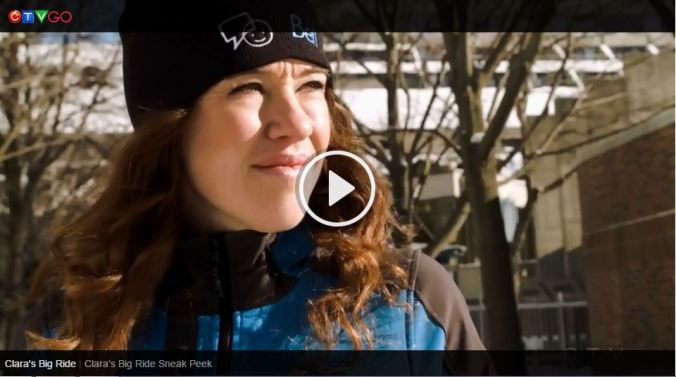
On Monday I announced that I would be part of an incredible documentary that was filmed last year. Now I’m providing you with a sneak peek (check me out at the 1 minute mark!).

Check it out here or click on the image below.

Part catalyst for change and part epic road movie, CLARA’S BIG RIDE is an inspiring new film that tackles the profound conversation about mental health and the stigma that surrounds it.

Capture

On January 28th, a.k.a. Bell Let’s Talk Day the film will be available on demand all day on CraveTV and CTV.ca. Also available on CTV, CTV Two and live-streamed on CTV Go at 7p.m.

Big news! Me, Bell Let’s Talk and a documentary

Hi folks!

So I have been teasing on Facebook for the past month or so that I had some BIG BIG news about Bell Let’s Talk day and me! Well the confirmation has finally come and I can officially SHARE!

Last March, I was interviewed by a team who was putting together a documentary about Clara’s Big Ride for Bell Let’s Talk. For those of you who don’t know, Clara’s Big Ride was a 110-day, 11,000 KM stigma busting journey across Canada that was done by the incredible Clara Hughes. And I have made it into the final cut of the documentary.

600x338_clara

Here’s Bell’s press release from the CTV website (I bolded my name for convenience!):

Bell Media announced the debut of the new original documentary “Clara’s Big Ride” as its anchor program for the fifth annual Bell Let’s Talk Day.

Premiering in primetime on Bell Let’s Talk Day, Wednesday, Jan. 28, the one-hour documentary will be available on demand all day on CraveTV and CTV.ca, before airing at 7 p.m. ET/PT in super-simulcast on CTV and CTV Two and live-streamed on CTV GO.

“Clara’s Big Ride” is a powerful documentary directed by multi-award winning filmmaker Larry Weinstein, chronicling an unprecedented 11,000 km bicycle journey across Canada by six-time Olympic medalist and Bell Let’s Talk spokesperson Clara Hughes. Throughout the journey, Hughes spreads a hopeful message designed to break the silence surrounding mental illness and helps create a stigma-free Canada.

Viewers can catch an encore presentation of “Clara’s Big Ride” on Wednesday, Jan. 28 at 12 midnight ET on TSN2.

Part catalyst for change, part epic road movie, “Clara’s Big Ride” is a rousing documentary that tackles the profound conversation on mental health and the stigma surrounding mental illness. Crossing every region of the country, the documentary features brave stories from Canadians whose lives are touched by Hughes’ historic ride.

In the spring of 2014, Hughes embarked upon an exhilarating journey on her bicycle in an effort to unite Canadians in a much-needed conversation on mental health, and to spark positive changes in the way mental illness is perceived. The documentary recounts the epic 110-day journey through 105 communities and 235 events in varied and often extreme weather conditions.

“The ride was all about connecting with people and putting them on the podium – elevating every Canadian to take the stage and tell their own unique stories,” said Hughes. “I’m honoured and humbled to invite Canadians in every corner of the country to relive this transformational journey, to share in the many voices and personal stories recounted in the doc. By talking, we can work toward creating a stigma-free Canada.”

Over the course of the documentary, “Clara’s Big Ride”  captures the voices of a group of heroic young Canadians as they tell their stories of living with mental illness. These voices include: Stacey, a teacher from Lindsay, Ont.; Marisa, a Media Relations Coordinator from Montréal; Antigonish, N.S. student Dexter; University of Prince Edward Island student Alanna; Dorothy, who runs a community program called “Going Off, Growing Strong” in Nain, a remote town in Northern Labrador; Sally, a practicing artist from Dawson City; Royal Roads University student Megan in Victoria; Canadian Armed Forces Veteran Terry; and Pascale, an outspoken teen and mental health advocate.

With Canada’s diverse landscapes serving as the film’s backdrop – from mountains to prairies, major to small cites, and remote communities – Hughes delivers a powerful message of healing to tens of thousands of Canadians in public squares, town halls, and schools from coast to coast to coast. “Clara’s Big Ride” not only captures the monumental effort of the ride, but also continues the conversation on how to build hope for a stigma-free future.

“This epic road movie will leave viewers awestruck at Clara’s tireless determination to tackle the sigma surrounding mental illness head on, while capturing  the magnificence and sheer beauty of this country,” said Kevin Crull, President, Bell Media. “This moving documentary serves to keep the conversation going about mental illness, and to break down the stigma – the very essence of Bell Let’s Talk.”

One of the greatest amateur athletes in Canadian history, with six Olympic medals in cycling and speed skating – two distinct sports crossing Summer and Winter Games – Hughes’ athletic prowess brought her national recognition, including the Order of Canada, and, just as she completed the ride, the Meritorious Service Cross. While cycling across the country, Hughes shares her own story of battling depression on the heels of her Olympic success.

A full complement of Bell Let’s Talk Day-related programming across Bell Media networks will be announced.

So on Wednesday, Jan. 28, check out my TV debut on CraveTV and CTV.ca before the official air time or tune in at 7 p.m. ET/PT on CTV and CTV Two and live-streamed on CTV GO. It will also be available the next day on CTV.ca.

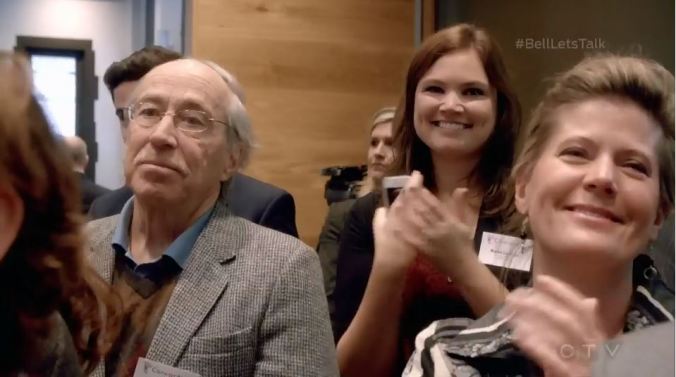
Also, I made it into the random still images on the CTV website

Bell Let's Talk

When suicide happens

Trigger Warning: Frank discussion of suicide.

Writing about suicide isn’t easy. I’ve been trying for a while to write this post, but I never know where to start. Do I start with my own story? How I have lived in that pit of despair that causes someone to actually think that taking their life is a solution? Or do I open with the staggering suicide statistics? Like, every 40 seconds someone commits suicide?  Or, did you know that HALF of ALL college students consider suicide at one point?

Neither options allowed me to find the right voice to speak about something as evasive as suicide. But then, last Wednesday, I received a text message that finally gave me the voice to talk about it. And that voice is mighty pissed off.
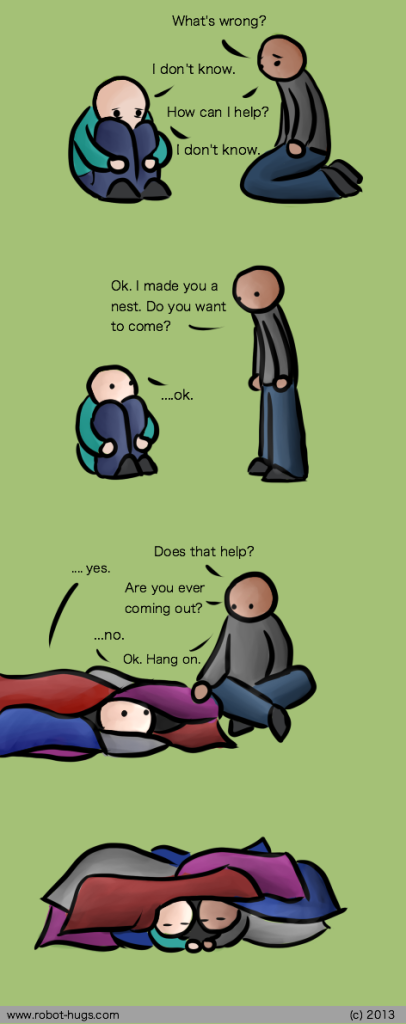
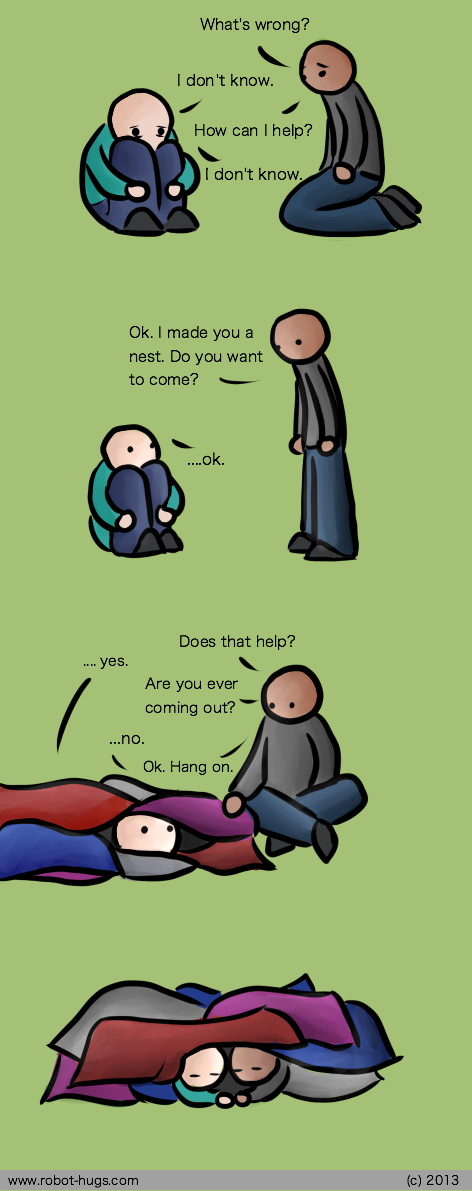
Robot Hugs blanket nest

It was 8:30 p.m., my husband and I were lounging on the sofa, catching up with our DVR, when my cellphone dinged. We have a rule that we try not to use our phones after a certain hour, unless we’re expecting news. If it had been one text, I would have ignored it. But it was the urgency of multiple incoming texts that made me break our rule.

It was my best friend. She had just found out that an acquaintance of hers had committed suicide (I didn’t know the person). She didn’t know her that well, they had only performed together once. Her friend, who had known the woman more intimately, had told her the news and he was devastated. My friend was in the middle of a rehearsal and couldn’t really talk, but she needed to tell someone who would understand. Who could offer advice on how to console her friend.

Despite being the bastion of mental health knowledge that I am, I was at a loss and caught completely off guard by her text. There’s no real way to prepare for the news of a suicide. Other than being there for them, listening to them, and giving them a hug if they want it, there’s no real way to console a friend or family member who is dealing with this type of loss.

The absurd thing about this situation is that in the past two months, this is the third suicide victim I have heard of (and I’m not counting the multiple suicides covered by the media, like Leelah Alcorn). I haven’t personally known any of the victims. It’s always a friend of a friend, but the news always hits me like a punch in the stomach, knocking the wind out of me before I am brought to tears. (I cry for the death of strangers because I feel a fellowship with people who have mental health issues and because I know that black hole of sadness all too well.)

Except Wednesday night, something was different. Maybe it was because it was my best friend who was distraught over this sudden news, or maybe it was because this was the third person, but I was fucking angry.

I was pissed off that someone was struggling so badly that they felt the need to take their life. I was fucking pissed that they were so desperate that death seemed like a better alternative than living. I was fucking pissed that they were clearly not getting the help they needed or deserved. I was fucking pissed that people would say how they never “saw it coming.” I was fucking pissed off because suicide shouldn’t happen, but it seemed to keep happening over and over again.

Suicide warning signs

Despite all the advances we have made in mental health awareness, suicide is still an issue that is shrouded in silence and secrecy. Suicide is treated like a “contagious” disease, as if you can catch it just by speaking its name. Maybe “suicide contagion” happens not because of the act itself, but because no one wants to talk about it. No one wants to talk about the fact that maybe they’ve thought about killing themselves before because it’s embarrassing and morbid. Or maybe they had a relative who committed suicide that no one talks about. Or maybe suicide just makes them feel terribly sad, even if they didn’t know the person.

There’s no easy way of talking about suicide because it’s hard to explain why someone would think killing themselves is a viable solution to their problems. As someone who has seriously thought about numerous ways to die, suicide is still hard to articulate. It’s a complex and confusing issue because it goes against one of our most basic instincts, self-preservation.

The thing is, suicide is never about wanting to die, it’s about wanting the pain to end. It’s about wanting to disappear. It’s about wanting whatever it is you’re struggling with to be over. If you’ve never battled with depression, anxiety, post traumatic stress disorder, an eating disorder, or any other form of mental illness it’s hard to understand the enduring and seemingly never ending psychic pain. It’s a pain that follows you like a shadow in your waking hours and haunts your dreams as you sleep. There is no escaping it.

Moreover, suicide is hard to talk about because of the pervading myths that surround suicide. I’m sure a researcher somewhere has done a fancy study with numbers, but I’ve been in enough social situations to know how dumb people can be about mental health and suicide.

I was at a party this past summer when the subject of suicide, self-harm, and mental health came up. I don’t know how or when the conversation started, but it was sudden and swift and I braced myself for impact.

“They say it’s a cry for help.”

“They do it for attention.”

“Well they say that you can tell a cutter from someone who really wants to die by the direction of the cuts.”

“How much of a loser do you have to be to fuck up your own suicide?” 

“I get why people jump in front of a metro – but everyone knows taking a bottle of Advil will only make you sick.”

These comments were tossed out over wine and cheese, in front of near perfect strangers. This is the stupidity and callousness with which suicide is discussed. It was complete thoughtlessness and ignorance that dominated the conversation.

Condescending Wonka

Don’t be a douche waffle when you talk about mental health & suicide

Let me demystify a few things about cutting and suicide – the two are not intrinsically linked. Just because you cut, doesn’t mean you want to commit suicide. Attempting suicide or self-harm are not cries for help and aren’t attention seeking behaviours. People who do these things are sick, just like someone who has cancer or diabetes, and they simply don’t know how to cope with their feelings or the world they’re living in. (The Canadian Mental Health Association has broken down more myths about suicide).

This is what I wished I had said at this party. But after bearing the weight of these words in silence, I made a quick exit in tears.

So it’s not that we shouldn’t talk about suicide because we’re afraid it’ll be contagious, but we need to know HOW to talk about it. We need to be SENSITIVE to our audience. We need to be CONSIDERATE of other people’s experiences. We need to be KIND and UNDERSTANDING.

Suicide isn’t an easy subject to broach and defies all logic, but we need to talk about it or else all of these deaths will have been in vain.

If you or someone you know is thinking about suicide know that there is hope. Here are contact numbers for organizations that help people in crisis.

Canada: 1-800-SUICIDE OR help lines and centers by province OR 911

US: 1-800-273-TALK

US LGBTQ Youth (the Trevor Project): 1-866-488-7386

US Veterans Crisis Line: 1-800-273-8255 (press 1)

InternationalBefrienders Worldwide

Australia:  13-11-14 (lifeline) or 1-800-55-1800 (kids help line for 5-25 yrs old)