Dispatches from the psych ward: A Walk

When you’re in the midst of suicidal depression, you wouldn’t think that something as insignificant like boredom and monotony would get to you. But when you’re inside the psych ward, it somehow gets to you in a way that is more profound. The psych ward isn’t like it is on TV. There is no group therapy sessions, there’s no one-on-one with a therapist, frankly, you’re lucky if you get to talk to the psychiatrist at all.

They do the intake, pump you with pills, and leave you to stare out a window.

The only sense that you get that any one cares at all is when they’re performing medical tests, but even those lack bedside manner. I have foggy memories of being woken by nurses drawing my blood for lithium levels. They couldn’t be bothered to do the humane thing and wake me up. Instead, I would wake, bleary eyed, semi-stoned by sleeping medication, mid blood-draw. Sometimes I was too fucked up by medication and would fall back asleep, dreaming of vampires with their daggered teeth sucking on my arm.

bird cage

Image courtesy of Gratisopgrahy

Of course I had brought books with me to the hospital — I don’t go anywhere without something to read. But the meds or the depression, or both, made it impossible to read. I would spend several minutes staring at the words on the page, watching them dance around before giving up in frustration. Besides, when people are screaming or arguing, concentrating on a story isn’t possible. Ever the writer, I also always have a journal with me. But just like reading, writing was just as fruitless. I tried writing about being in the hospital, it could be fodder for a novel someday, but the words just wouldn’t come. It was like a mental damn had been put between my brain and the pages.

Everything felt so damn pointless.

After several days of trying to read and write, I finally gave up. Sleep was the only thing that made it feel like time was passing in the hospital. So, my goal was to sleep until they decided I could go home, but even that was taken from me. Inevitably a nurse on her rounds would rouse me.

“You can’t stay in bed all day, you know. Get up!”

“Why? What’s the point?” I asked. “There’s nothing to do.”

“You could socialize with other patients. You could start a board game with some of them.”

I rolled my eyes, pulling the scratchy, over starched hospital sheet over my head.

“Well you can’t stay in here.” She pulled the blanket off my head and practically pulled me out of bed. She guided me to the red, faux-leather chairs that lined the hallway. They all faced a wall-to-wall window that looked into a small courtyard. It was double sided glass so that we could watch people coming and going outside, but they couldn’t see onto the ward. There was a nurse eating lunch in a gazebo. “I don’t care if you sit here all day, but it’s better than being in bed.”

And so I sat there, staring out at the window, thinking about how much I hated her, this place, and my illness.

“It’s time for the nature walk,” the nurse who had roused me from bed announced. She had gotten me out of bed, but I was not going to go on a nature walk. Who were they fooling anyway? We were in the middle of a suburban city, the only nature was Lake Ontario and it was a cesspool of toxic sludge.

“I’m not going,” I replied, without looking away from the window.

“Why not?” She asked.

“I don’t want to.”

“Well, there’s nothing wrong with your legs so you’re going.”

“I thought these activities were voluntary?” Ha! I caught her there. These activities were supposed to be completely voluntary but they couldn’t force me to do anything I didn’t want to do.

“You are expected to participate and if you don’t it will be noted.”

Ah, the dreaded, this will be put in your file for the psychiatrist to use against you argument. Thinking on my feet, I said: “I can’t go for a walk. These meds are making me dizzy and I’m afraid I’ll pass out.”

“Stop lying. You’re going for the walk.”

“I’m not lying.” It was a total lie. but I wasn’t being argumentative just for the sake of arguing with her and making her day as miserable as mine was. Although, I knew some people in here who used to bother the nurses because it was about the only fun thing to do in here.

The reality was that I was terrified of running into someone I knew. The hospital was right on Lake Ontario and the boardwalk. It was inevitable that the “nature” walk included walking along the water. Hanging out by the lake was what everyone my age did. It was a beautiful spring day, there would be hordes of them. What if I saw someone I went to high school with? How would I explain the hospital bracelet and the group of weirdos I was with?

“When you see the psychiatrist, you can tell him about the meds making you dizzy, but I think the fresh air will be good for you.”

I sighed. It wasn’t in my nature to be argumentative and between the depression and medication, this was all the fight I had in me. I conceded and joined the group that was getting ready to leave.

The psych ward was on the first floor of the hospital and we had to walk through the main entrance to get outside. We left the ward, following a nurse like a gaggle of ducklings following their mother. Another nurse brought up the rear. I could feel the judgement as people entering the hospital stared at us, wondering where our little rag tag crew came from.

We walked down a slope and through a parking lot to get to the boardwalk. I had been here so many times with my friends, eating ice cream, laughing and shoving. My current boyfriend told me he loved me in this very spot. There was a compass painted on the ground and if you stood in the centre and spoke, your voice would echo back. I don’t know why they had made it that way.

I look ahead and see a woman walking her dog. Anxiety creeps into my body. What if it is someone I know? I slow my pace and move away from the centre of the compass where the rest of the group was testing out the echo. I face the rocky shore, pulling the cuff over my hospital bracelet and watch the water.

Virginia WoolfIt is still early spring and despite the cold wind, the sun is warm on my face. The fresh air making the stench of the hospital a distant memory.

As I watched the water hit the rocks along the shoreline, all I could think of was Virginia Woolf’s suicide. With rocks in her pockets, she walked into the River Ouse. Leaving a note to her husband that read, “Dearest, I feel certain I am going mad again.”

The landscape transforms before me and I can see Woolf walking into the depths of the water. She looks back and her face is my own. I can feel the frigid water of Lake Ontario soaking through my clothes. I hold the heaviest rock I can carry in my hands. The current carries me like I weigh nothing into the middle of the lake. Between the weight of the rock and my clothes, I am drowning.

And then I hear the voice that wakes me from my fantasy, “You’re straggling behind Marisa.”

Bipolar Mixed State: Into the breach

This week has been extremely difficult. I have been in the throes of a bipolar mixed state. This means that I am simultaneously experiencing a depressive and hypomanic episode. This means that I have been dealing with rage and agitation while simultaneously being too exhausted to move. It is like being at war with yourself. Like hypomania, there is no sleep, but unlike hypomania there is no excess of energy. There is no elation. There is no abundance of life. Instead you are morose, sad, and teary.

Battle

Photo courtesy of New Old Stock

I have spent the week trying to tamper the rage and muddle through my responsibilities with the exhaustion. The anger comes in waves. No, a wave is too gentle for what happens. The rage is more like a tsunami. The sheer force and violence picks me up like I am nothing more than a shred of paper. It thrashes me about until I am bruised and battered. My skin raw and bleeding. Anger, like water, fills my nose, mouth, and lungs; it threatens to drown me. I try and scream, but all that comes out is a sigh. I try and fight it, swimming hard against its current, but it’s useless.

The anger suffocates me until, like the natural ebb of the ocean, it leaves my body. I am left exhausted and defeated. Going through the routine of my life after the sheer violence of the rage is like swimming through mud with limbs made of lead. But just as I feel that I have a handle on things, just as land is in sight, the water swells and pulls me back again into its watery violence.

In addition to bouts of uncontrollable rage, I have been battling intrusive thoughts that can be downright terrifying. Please know that these are different than suicidal thoughts. Although I do think things like — that’s a big bus, it wouldn’t be terrible if it hit me by accident and I died. I mean, everyone is plotting against me and would rather that I was dead. They all hate me. They all think I’m a drama queen with this bipolar disorder thing.

But of course no one is actually thinking these things. My brain deforms acts of kindness, acts of indifference, acts of the everyday into something twisted and ugly. The actions of other people are gnarled until they are unrecognizable and I question my sense of reality.

It is hard to focus on work and responsibilities when your life is a battleground and land mines are everywhere. But I persevered, because that is what I do. I survive, despite the way that I feel. I push myself into work, smile, socialize, do what is asked of me. I try even harder to appear normal. All the while I am fighting the rage, paranoia, and exhaustion. I really just want to crawl into bed, pull the covers over my head, and cry.

Drawn and quartered

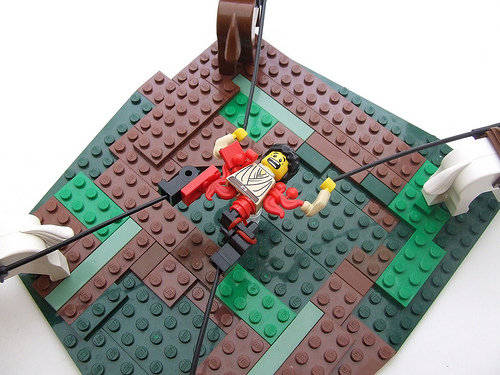
I thought a Lego man was less grisly depiction of being drawn and quartered.

Perhaps I am so tenacious in this state because I have spent the last 29 years of my life being drawn and quartered. I imagine horses tied to each of my limbs and a mysterious voice yelling for the horses to pull. My limbs rip from my torso as I try and fulfill all of the demands of everyone else, rather than what I need and want.  The voice that commands the horses is constantly criticizing what I am doing and telling me what I should be doing instead, regardless of how I am feeling.

I am sitting on the couch and it asks, “Why aren’t you at the gym?”

“Because I’m tired from fighting my fucking life.” I always start out tougher than I feel. I always feel like I can argue with the voice.

“That’s no excuse,” it snaps. “You could at least be working on your novel or your blog. Isn’t that what you really want to do with your life? Write?”

“Yes, but I’m really fucking tired because this week has been really hard.”

“Hard, you don’t know what hard is. You’re a pampered princess. Do you know what’s hard? Those kids in Africa who have to walk 10 kilometers each way just to get water for their villages. That’s fucking hard.”

“I know, but -”

“You’re just lazy. You’re a useless excuse of a human. You are pathetic. You are worthless.”

And that voice usually convinces me to do something – whether it’s hit the gym, clean the house, work on my blog – even when all I really want to do is curl up and sleep because I have been battling the ghosts that paranoia brings and tampering the rage the swirls inside of me. Even though I have been doing all of these things that take incredible amounts of energy, it pushes me to deplete myself further and further.

But it wasn’t until Friday that I finally told that voice to shut the fuck up. I will write my blog post when I get to it – if I get to it. I will go to the gym next week when I have slept a solid eight hours. I will socialize when I no longer feel like everyone is against me. For now, I will sit on the couch and watch TV. And that’s okay. That’s enough. I’m enough. And surprisingly, the mood lifted just a little. If only for a little while.

Medicating Women’s Moods

[Note: I know in my last post I said that I was going to write about my time in the psychiatric ward, but then I read an article and my reaction was so strong that I had to write a rebuttal. So, I promise to continue my Dispatches from the Psych Ward series next week.]

Last week, The New York Times published an op-ed by psychiatrist Julie Holland called “Medicating Women’s Feelings.” I read it because I was hoping it was going to be a critique of how society has historically used psychiatry and pharmaceuticals to control women’s bodies and behaviours. Unfortunately, it ended up being a bad lesson in biological determinism, stereotypes, and oversimplification.

There are sweeping generalizations and stereotypes made throughout Holland’s op-ed. But my favourite one comes in her first sentence: “Women are moody.” There are roughly 3 billion women in the world and, according to Holland, we are all moody. In an article for The Frisky, Katrin Higher, argues that:

What she [Holland] fails to mention is that our particular biological expressions of fears and desires…are not any more moody than men’s particular manifestations of moodiness. Just because we may cry after something troubling, doesn’t mean a man won’t punch a wall (and maybe a woman will punch a wall, actually that sounds fun and I may try it) for a similar feeling.

Mood SwingKatrin is right. Some women may cry after something bad happens, but that doesn’t mean a man won’t react in some other way. Or, heaven forbid, they might actually cry! My point is, not all women are moody. It’s just ridiculous to think that all 3 billion of us react in the same way to situations. Some women are moody, but I also know a hell of a lot of men who are a lot more fucking moody than I am (and I have a disease that makes me pretty fucking moody).

Another issue with Holland’s op-ed is the overarching message that suggests that women’s “emotionality” is a source of untapped power and by medicating ourselves, we are losing this power. As someone who is both a woman and takes medication for a mental illness, does this make me less of a woman? Moreover, what about the trans community? Are trans women less of a woman because they don’t have the biology to make them emotional? Of course not! These sweeping generalizations about gender and emotions serve no one.

ValiumMoving beyond the oversimplification of women’s moodiness Holland argues that the pharmaceutical industry is “targeting women in a barrage of advertising on daytime talk shows and in magazines.” And she isn’t wrong. Since the advent of Valium being marketed as “Mother’s Little Helper,” psychotropic medications have been disproportionately marketed towards women. In a 2003 study Jonathan M. Metzl provided a visual history of how “psychotropic treatments became imbricated with the same gendered assumptions at play in an American popular culture intimately concerned with connecting ‘normal’ and ‘heteronormal’.”

If a woman was a lesbian, perceived as sexually promiscuous or frigid, or didn’t want to be a wife or mother, she was labelled as sick and often given medication until she agreed to the path set out for her by patriarchal society (check out Women and Madness by Phyllis Chesler for more about this). However, this was also true for gay men or other people who didn’t fit into heteronormative society. Keep in mind, homosexuality was only removed from The Diagnostic and Statistical Manual of Mental Disorders (the psychiatric bible of diagnosis) in 1986.

Medicated Holland is also not wrong in saying that women are overmedicated. She contends that “one in four women in America now takes a psychiatric medication, compared with one in seven men.” However, I would suggest that the disproportionate use of medication between men and women may be skewed by the fact that men are less likely to seek help for their mental health and are therefore less likely to be given medication. Men have been taught that they cannot show their emotions whereas women have been told it’s okay to be emotional (unless they’re too emotional, in which case they’re crazy or on their period). This ties back into the dangers of Holland’s assumptions about emotions and gender. If we believe that women are allowed to be emotional because it’s more “natural” to them and teach boys that they are not – how are the expected to then seek help when they are struggling with their mental health?

I would also argue that society as a whole, and not just women, are overmedicated. We want a quick fix for our mental health and therapy takes time. The global pharmaceutical industry is valued at approximately $300 billion and they spend roughly one third of all sales revenue on marketing rather than research. And it’s not just Big Pharma making profits on us popping pills. Doctors are profiting big-time by shilling certain medications over others. This has become such a major issue that one of Canada’s largest medical regulators, the Ontario College of Physicians and Surgeons, is barring doctors from receiving any gifts from pharmaceutical industries. And the same is happening in the U.S.

However, this isn’t to say that medication doesn’t have a role in treating mental illness. A lot of people, myself included, benefit from taking medication to manage our moods. It’s just that when your doctor and Big Pharma can team up to push a certain medication, you have to start questioning whether or not we really need that antidepressant or not.

It’s not that Holland’s op-ed is entirely wrong, it’s just that she lacks nuance and contextualization for a lot of her assertions. Both women and men are emotional beings who have the capability to suffer from mental illness. And whether you choose medication, therapy or both it’s important that you seek help for your mental health and choose the treatment that’s right for you.

In case you want to read more in response to Holland’s op-ed, The New York Times published a series of letters.

Admission: Dispatches from the Psych Ward

[The next few blog entries are going to be about my time spent in the psychiatric hospital. There won’t be any chronological order to them as they are mostly snippets of my time. Some of the things that I talk about in the stories aren’t going to be politically correct and are a reflection of my own state of mind and lack of education in mental health at the time. Please don’t be angry by some of the snap judgments I made].

“Do you think you need to be admitted into the hospital?” My therapist asked me. I was at my weekly session in the outpatient treatment centre attached to the hospital. I had left work on my lunch break and drove across the city to make it to this appointment. Frankly, I was more concerned about getting back to work on time than I was about getting help.

“Of course I don’t need to be admitted into the hospital,” I scoffed at her. Although I had been battling with my mental illness for about four years, this was the first time anyone had suggested that I go into the hospital. I didn’t belong in the hospital. I wasn’t that crazy. I’d had some suicidal thoughts here and there, but surely these didn’t warrant being institutionalized, right? Besides, the hospital was for bad cases. You know, the one’s who were seeing the devil or thinking they were the reincarnation of Jesus. I was just depressed. I didn’t need to be locked up with the loonies.

“But you just admitted to having suicidal thoughts…”

She had me there.

This had been my first mistake; admitting to her that I was thinking about suicide. Sometimes I speak without thinking of the ramifications and in this case, talking about killing myself during a session was a major faux pas. You see, when psychiatric professionals hear the S-word, they immediately go into action mode. I guess I looked like enough of a mess that I might actually act on my suicidal thoughts. That was my second mistake. I didn’t look as put together as I normally did. Frankly, I had been too damn tired to put on makeup. It had been days since I slept and I was losing touch with reality. So putting on eyeliner was the least of my concerns. Besides, the therapist had seen the fresh self-harm wounds from a mile away. Therapists are perceptive like that. My attempt at camouflaging them with bandages and bracelets was futile.

Although, i had already learned that the hard way at work. A female coworker had had called attention to the cuts on my arms and wrists.

“What are you trying to do? Kill yourself or something?” She asked, laughing hysterically as if she had just made the funniest joke in the world.

Imagine I had actually responded honestly?

“Yes, actually. Every night, instead of sleeping, I cut myself because the anxiety I have is so intense that I feel like I  may actually explode. The cuts act as release valve on the pressure I feel. And you know what? While I’m cutting, I’m actually thinking about ways to kill myself that would be the least inconvenient for everyone. Wanna hear what I’ve come up with? The best way to commit suicide is to take all of my medication with a mickey of vodka. What do you think?”

But because I’m depressed and frankly don’t have that sort of personality, I simply ducked my head and vacated the scene for the washroom before bursting into tears.

“I can’t go into the hospital,” I said to my therapist. “I have to get back to work. They can’t function without me.”

“Do you really think that?”

In response, I burst into tears. In my mind everything was dire, end-of-the-world serious. And so yes, I did actually think that if I didn’t return to work the world would, in fact, stop rotating on its axis.

One Flew Over the Cuckoo's Nest“Marisa, I’m going to see if there’s a bed available for you today.” She handed me a tissue as she got up from her desk. She was a blur of grey hair and beige clothing as I watched her leave the office.

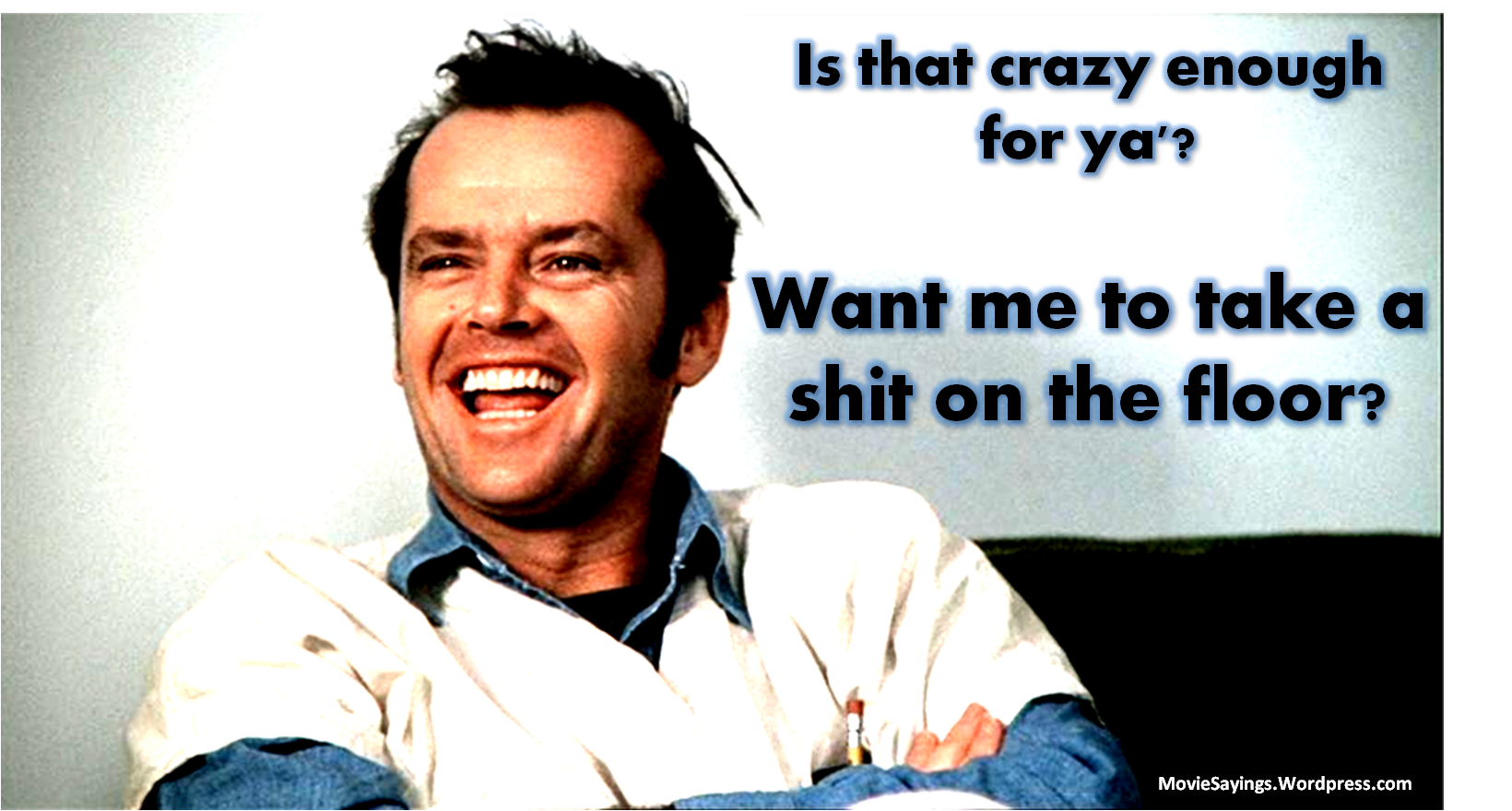
The familiar prickle of anxiety was forming in my hands and feet. Unable to sit still any longer, I got up and began pacing in her office. All I could think of was One Flew Over the Cuckoo’s Nest with Jack Nicholson. Images flashed through my mind of Nicholson convulsing on the table as he received ECT. Do they even do that anymore? Would they do it on me? Or what if they just injected me with a whole bunch of medication and I was just one of those zombie patients doing the sedation shuffle across the ward? I could almost hear the raving lunatics screaming in the night, begging for help.

“You’re lucky,” my therapist said as she came back into the room breaking me from my imaginings. “A bed just became available.”

I laughed out loud. Lucky? How the fuck was I lucky? I was going to be institutionalized. 

Later, when I would be hospitalized for a second time, I would realize that I really was lucky that day. Psychiatric beds are hard to come by and my second hospitalization included a week-long stay in emergency because there were no beds. The psychiatric ward is bad, but staying in ER for a week before you are transferred is even worse.

“Do I have to go?” I asked, tearing at the tissue in my hands. My stomach was a tight knot and I felt like I could puke at any moment.

“Well, I can’t force you into the hospital, but I strongly recommend it,” she said gently. “We’re able to make more dramatic medication changes when you’re hospitalized and hopefully get you sleeping. Wouldn’t that be good?”

I shrugged. “What about work?”

“You’re not going back to work,” she spoke more sternly this time. “You’re sick, Marisa.”

A different person would have protested and fought, but I have been conditioned to obey authority figures and defer to their professional opinions. If my therapist thought I should be in the hospital, I should be in the hospital. Despite my reservations and fears about the whole thing, there wasn’t any arguing to be done.

“But what will I tell work?” I asked, always worrying about how I was going to disappoint someone. “I have shifts this week.”

“Your’e going to call them and tell them that you’re going to be admitted to the hospital for an illness. But you don’t have disclose what.”

So I called my mom who then called work to explain the situation. And when I was released from the hospital, I never went back for fear of embarrassment. I don’t even think I collected my last pay cheque. At least I never had to see the bitch who made fun of my self-harm scars again.

To be honest, I don’t really remember how the next few hours proceeded. My parents showed up to the hospital with a bag packed with my things and before I knew what was happening I was being herded into the psychiatric ward.

As they buzzed me into the ward, I was hit with the sharp smell of antiseptic and sickness. There’s something about the way that sick people smell that makes me nauseous. But the psychiatric ward had the added scent of greasy hair and unshowered bodies. I understood what it was like to be depressed and unable to shower, but in that moment I swore I wouldn’t become like one of those people. I vowed that I would shower every day. That was, until I realized how inconvenient it was to shower on the psych ward.

Taking a shower was a multiple step process. First, you had to get the attention of the nurses at the nurse’s station. Then you had to ask if you could take a shower because one of them had to be on duty outside of the shower room. If no one was available, you’d have to come back later. If someone was available you would then have to go through the process of collecting your shower products. Once you were in the shower, you would be interrupted every few minutes by a nurse asking if you were okay.

Eventually, it became easier just to not shower. Besides, who’s seeing you except your psychiatrist and your family who came to visit? And as I would learn, looking disheveled got you taken more seriously by your psychiatrist than looking clean and shiny.

After being admitted into the ward, I was escorted to my room. I cried as I walked down the long hallway, clutching my pillow at my chest. I glanced into one of the rooms as we walked by and saw a woman sobbing into her hands on the side of the bed. I couldn’t believe my mental illness has gotten me here. I know my therapist thought this was the best place for me, but surely it wasn’t. This had to be a mistake.

Crazy Cat LadyFinally, we stopped outside of one of the rooms. As I entered, I was horrified to see that I would have a roommate. The curtain that divided the room was pulled back to reveal a sleeping woman in her 80s. She looked like Eleanor Abernathy, a.k.a. the “Crazy Cat Lady,” from The Simpson’s.

I had never shared a room with anyone, let alone a complete stranger. What if she had a psychotic break in the middle of the night and tried to kill me in my sleep? Or what if she screamed in the night? She was the personification of what every crazy person ever looked like.

Seeing the fear register on my face, my mom said, “Well, at least she doesn’t look chatty.”

And she was right. “Eleanor” wasn’t chatty because she had some how lost the ability to speak. She had extreme dementia and her family had dumped her here when they couldn’t handle her any longer. Her meals were brought to her room, but she barely ate. She was on so much medication to manage her dementia that she spent most of her time sleeping. The strangest thing she did was pee with the door open and the light on. Once in a while she would scream in the night, but I couldn’t possibly begrudge her that because I felt so terrible for her. I never once saw her family visit.

The nurse ran through the rules of the ward and then searched my bag for contraband (i.e. things that I could possibly use to kill myself with, which included my tweezers in my makeup bag. For some reason, makeup seemed like a good thing to bring to the psych ward). They also confiscated my purse and they would have kept my cellphone and charger had I not hidden them in my pocket.

Then the moment came when my parents had to leave. The nurse left us alone in the room and I started to cry again. Some words were whispered about this being the best thing for me and how they would come and visit every night. I wouldn’t be in here very long.

And then they left. Leaving me alone with my snoring roommate and my fear.

Working with a mental illness

High stress workplaces and overworked employees aren’t anything new when it comes to North America. However, recently The Atlantic reported on a working paper from Harvard and Stanford Business Schools that investigated the impact that job stress had on the health and mortality of American workers.

“The paper found that health problems stemming from job stress, like hypertension, cardiovascular disease, and decreased mental health, can lead to fatal conditions that wind up killing about 120,000 people each year – making work-related stressors and the maladies they cause, more deadly than diabetes, Alzheimer’s, or influenza.”

It’s incredible that 120,000 Americans are dying each year because of workplace stress. It’s not particularly surprising when we think of our climate of work and our glorification of busy. If you’re not busy, you’re worthless! We base our value on how many things we are able to achieve in a day. If we’re not exhausted and exasperated at the end of the day, then our day wasn’t worth anything. If we can’t complain about how tired and busy we are, our lives don’t matter.

Hamster wheelI have been on sick-leave for the past 5 months and have stepped off of that hamster wheel of stress, Only now have I been able to look critically at my work self. I already knew I was a perfectionist workaholic (I take after my dad in that regard). But, I hadn’t realized that I had been conditioned to say yes to everything and respond to additional work with a smile and can-do attitude because I was told that’s what team players do. That’s what hard workers do. That’s what people who get promoted do.

But it’s not.

That’s what doormats do.

That’s what people who cannot establish boundaries do.

Now that I have established distance from work, I recognize that it wasn’t just unmanageable workloads and difficult colleagues that caused my latest relapse (although they were major players). It was my inability to ask for help and not establishing boundaries with colleagues that really made me sick. If I had the strength to tell my boss sooner that I was floundering under the weight of my workload instead of trying to do it all, maybe I wouldn’t have relapsed. Now I can see that the workplace may create stress, but only I have the power to stop these situations from impacting my mental health.

WorkingThis week I will be returning to work. It will be a gradual return that will take about 8 weeks until I return full-time. To say that I’m nervous is an understatement. I am terrified that being thrust back into the pressure cooker will completely destroy me this time around. All of these realizations that I have had about my role in my own sickness are great, but will I actually be able to say no? Will it be possible for me to do my job without making myself sick? I run through hypothetical scenarios with my therapist and in those moments I can say: “No, I have too much to do. If you want me to complete that task then you will need to take something off my plate.” But when it comes down to it, will I actually do it?

I hope so and I’m going to try my hardest.

Whether you have a mental illness or not, boundaries are critical in maintaining good mental health as the Harvard and Stanford paper illustrates. However, as someone with a mental illness, I must recognize my limitations and work around them. I have to understand that asking for help isn’t a sign of weakness, but a sign of strength. My ability to say no will not only benefit my health and future, but it will also benefit my employer.

Wish me luck!