Tom Sullivan responds to his remarks about bipolar disorder

You’ll recall last week that Fox Radio host, Tom Sullivan, said on his January 28th show that bipolar disorder was a “fad” and “made up.” On February 4th, Sullivan posted to Facebook to say that his comments were “taken out of context” and that he believes “bipolar is real and is a mental illness needs to be treated.”

Here’s his full response:

A REPOST FROM YESTERDAY: I received a nice email from Gina about my comments. Here is my response to her: Gina,
Thank you for your email. May I tell you I have received a number of similar messages but usually laced with profanity. Your message stood out for the kindness of your words.
First, I need to tell you I do believe in bipolar disease. There is a two minute clip going around of my comments out of a two hour discussion. It is easy to take comments out of context. Of course I believe bipolar is real and is a mental illness that needs to be treated.
The program began with the subject being the huge increase in disability claims made to the Social Security Disability Fund which is going broke in 2016. The increase in claims is startling and the number one reason for the big increase in claims is mental illness and a subset (according the way Soc Security categorizes) of mood disorder.
All I was trying to do was to point out that out of that big increase I suspect there are people who are not sick but looking for a disability check.
My further point was by doing so, those people were hurting those who really are sick and need help, i.e. funding, treatments, etc.
I have for years advocated on my program for more funding and insurance coverage of mental illness. Too many have ignored it and as a result our jails are now the “mental institutions” where the people get zero help.
I apologize to those who were hurt by the clip of my comments. I am a somewhat jaded person who thinks some people are gaming our system due to their greed. But, I also believe mental illness is a very serious problem that is ignored by too many.
This episode shows how easy it is to distort a persons comments, especially when the subject is very important. It will and has reinforced my commitment to making mental illness on a equal par with physical illnesses instead of the stigma it currently receives.
Again, thank you for your email and your concern,
Tom

Media Matters for America (MMfA) posted a transcript of the 2 minute clip where he repeatedly told a caller that her bipolar disorder wasn’t real and that people shouldn’t receive disability benefits for depression or anxiety.

I would like to ask, which comments exactly were taken out of context?

Was it:

“I think bipolar is like the latest fad. Everybody and their brother is getting diagnosed with bipolar. And last time I checked, we all have good days and we all have bad. And I don’t consider that an illness. And I don’t consider it a disability.”

Or maybe:

“I just think it’s something made up by the mental health business just to be able to give people prescriptions and keep them coming in, and keeping you — paying them money.”

Or perhaps:

“I don’t know why we have to create these new illnesses, and create all these medicines for something that really wasn’t a problem in the first place.”

These comments do not sound like they were spoken by someone who considers bipolar disorder to be a real “mental illness that needs to be treated.” These are comments made by someone who has not had direct lived experience with any mental health problems nor has he had to care for someone with mental health issues. Sullivan’s comments were made, whether intentionally or not, by someone deeply uneducated about mental health.

Whether or not he believes people with mental illness need disability benefits really isn’t the point (although it is a significant problem). The point is that he told someone who was trying to relate her lived experiences that she was wrong and in doing so, he discredited the lived experience of millions of people around the world. His comments reflect how many people think about mental health — that it doesn’t really exist and is “all in our heads” or created by Big Pharma to sell drugs.

Sullivan, and others who think just like him, are the reason I have to speak about my mental health. I do it for those who can’t and I will continue to shout about mental illness until I lose my voice and I will keep writing until my fingers fall off. I will keep talking about mental health until no one makes ignorant comments like Sullivan, whether intentional or not. I will continue to speak until people stop using mental health diagnoses as adjectives. I will continue to speak until people stop self-harming and committing suicide. I will continue to speak until everyone struggling with mental health feels comfortable speaking up and asking for help.

Bipolar Disorder isn’t a fucking fad

An American report by the Social Security Administration (SSA) found that “one in three, or 35.2 percent of people getting federal disability insurance benefits have been diagnosed with a mental disorder.” The SSA reported that “disabled beneficiaries have increased 49.7 percent over the past decade” and the “largest ‘diagnostic group’ for disabled beneficiaries was a mental disorder.’ Moreover, not only are the majority of people who are receiving disability benefits suffering from some form of mental illness they are largely diagnosed with a mood disorder.

SSA chat on disabilities

As the pillar of journalistic integrity and high quality news reporting, Fox News Radio host, Tom Sullivan, took to the air to talk about all of these lazy bastards receiving disability benefits:

On Wednesday’s show, Tom said there are too many Americans with “mood disorders” who are gaming the system by collecting disability! He argued that many of these people can still work and support themselves.

You know, all of these people with their imaginary illnesses, like bipolar disorder, need to pull up their bootstraps and stop their parasitic sucking on the American people’s resources. You know, so we can better fund, like, the military or something.

In an attempt to educate Sullivan, Aunglee from Saramento, called in to talk about her bipolar disorder and how the benefits she receives are integral to living a healthy and happy life. I have to give Aunglee credit because she was so calm and level headed it was incredible because frankly, I lost my shit just listening to their conversation.

Media Matters for America (MMfA) transcribed the interview in full and you can listen to it there, but here’s my favourite part. Sullivan actually had the balls to tell this woman that her Bipolar Disorder is “made up” and is a “fad” perpetuated by the pharmaceutical industry:

I’m very skeptical. And I’ve got to tell you, if you haven’t been told, I will tell you. I think bipolar is like the latest fad. Everybody and their brother is getting diagnosed with bipolar. And last time I checked, we all have good days and we all have bad. And I don’t consider that an illness. And I don’t consider it a disability.

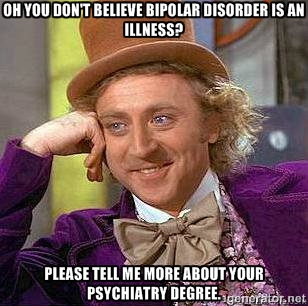
Condescending WonkaBipolar Disorder isn’t some Hollywood trend like juicing or detoxing. It’s a disease that psychiatrists can diagnose and treat with medication, or some people are really lucky and can manage their moods just with therapy. Bipolar Disorder is a disease that wreaks havoc on families and ends lives. Bipolar Disorder isn’t just the ups and downs of regular life. It’s not just being sad because your hamster Fluffy died. It’s wanting to drive your car off of a bridge because you’re experiencing suicidal depression. It’s not just about being happy, it’s about being so manic that you start to believe you are the second coming of Jesus Christ – but someone could totally go to work then, right?

I have bipolar disorder and have been on sick-leave for almost five months. My hypomania caused rage that made me afraid of myself and what I might do. My depression was so crippling that all I could do was cry for hours on end. If dealing with the mood fluctuations wasn’t enough, I was a guinea pig for medication adjustments that caused further intense mood swings and side effects. These medications made me dizzy, made me forgetful, made me nauseous, and gave me crippling headaches. At multiple points in my recovery I couldn’t string a sentence together, and as a writer that is something that is extremely important to me. And let’s not forget, the drowsiness. I spent almost a week sleeping because I literally couldn’t open my eyes. But it’s not a disability, right?

But Bipolar Disorder “didn’t exist 25 years ago” until Big Pharma got involved. You know, because according to Sullivan, Bipolar Disorder is “made up by the mental health business just to be able to give people prescriptions.”

Actually, 25 years ago, people with bipolar disorder were called manic depressives. The term manic depression was coined in 1899 by German psychiatrist Emil Kraeplin who developed the classification system for mental illness. The term Bipolar Disorder wasn’t used until the 1980s when the DSM-III was released, which was seen as a revolutionary text in psychiatry (DSM-III and the transformation of American psychiatry: a history). So the disease has existed for over a hundred years, but bipolar disorder is just a fad, right?

So why change the name of an illness that had existed for over 80 years? Stigma (surprise, surprise!) In the introduction to her book, Bipolar Expeditions: Mania and Depression in American Culture, Emily Martin cites a 2002 press release by the Depression and Bipolar Support Alliance who were changing their name from the National Depression and Manic Depression Association because, “many people are frightened by the term “manic depression” and this keeps them from contacting us for help.

I often get asked why I speak so openly about my experiences with mental health and it’s because of people like Tom Sullivan. Everyday of my life I battle against my disease. Everyday I take pills that are somewhat poisonous to my body, not because “somebody’s talked me into feeling and thinking this way” but because they are my lifeline. They are literally the only way I can function like an average person and even then I have mood blips that aren’t “normal” (whatever that means).

So before you start to discredit someone’s lived experience with mental illness, maybe you should shut up and listen. Or, at least read a book.

Hold on: Find your depression life preserver

It’s been a hell of a week. Despite all of the wonderful things happening around me: my Facebook Page has reached just over 300 likes, I’m going to be in a documentary about Clara’s Big Ride, I had a journalist from Elle Canada contact me about a post I wrote on self-harm, my depression was so bad that I thought I was going to have to admit myself into the hospital.

On Monday, I spent three hours sobbing in bed without any explanation. I woke up in the morning and I felt off kilter but I figured it was because I hadn’t had a full night’s sleep in over a week. I had been experiencing terrifying nightmares. Not just nightmares where you’re late for work or you show up to your presentation naked, but the kind of nightmares that make you question your brain. Nightmares where I was gang raped, nightmares where I watched my husband’s throat get slit before they did my own. These nightmares woke me up, panting and sweating and unable to go back to sleep. I was afraid to sleep because I was afraid of the nightmares that might happen.

It's Okay to CrySo Monday was day five of this sleeplessness and in hindsight I should have contacted my doctor earlier, but I thought it was just anxiety. By Monday afternoon I was in full blown crisis. My husband came home for lunch and he could read it on my body that I was in a bad way. He decided to stay home because he was afraid. There’s nothing that can quite make you feel as guilty as someone telling you, “I can’t go back to work because I’m afraid I might find you dead when I come home.” That’s when he asked me, in between my sobs and screams of frustration, if he should bring me to the hospital. And that’s when we both realized, we had no idea where to go.

We have been living in Montreal for about four years now and my mental health issues haven’t been prominent enough for us to think about this. It’s not that I haven’t been struggling because I have been. If you’ve been following this blog, you know that I have had to take time off of work because of my mental health, I have been experiencing daily panic attacks that have only recently abated, and I had a full blown hypomanic episode.

But, there’s a fine line between anxiety, depression, and hypomania that is manageable from home and that place that makes you and everyone around you so completely helpless that you resort to checking yourself into a psychiatric ward. My husband and I have been there before and it’s never an easy decision.

Finally, I decided to take a Clonazepam just to calm myself and I took a nap. I napped to hang on a little while longer. Two hours later, I woke up and felt I didn’t need to go to the hospital and I could hang on until I could speak to my therapist on Tuesday. Tuesday came and I felt worse than I did on Monday, but at least I couldn’t cry anymore. I couldn’t do anything. I sat in front of my computer and watched my Twitter feed until I could speak with my therapist.

I just want to say that I have the most amazing therapist in the world because she is out of the country and still responds to my e-mails that are written mid-panic. She called me from wherever in the world she is and calmly explained that she felt it was simply lack of sleep that was making me feel so despairing. She reminded me how when I lack sleep, I feel like a totally different human being. She told me to get off the phone and make an emergency appointment with my doctor.

Depression problemsWhen i saw my doctor on Wednesday, my husband accompanied me because he didn’t want me playing down or intellectualizing how badly I felt (I have a bad history of that). However, I think my doctor was able to read me well enough to know that I was not doing well. I was a mess. I was unshowered, greasy haired, dressed in leggings and an oversized sweater, and on the verge of tears. She increased my dose of Seroquel to essentially tranquilize me into sleep and a referral to the local psychiatric hospital, just in case, since she wouldn’t be working over the weekend.

Now for any of you who have taken Seroquel before, you know what this is like. If you’ve never taken Seroquel well it hits you like a truck. The sedation is intense. This is not a drug to be fucked with. It knocked me out but I could barely function. Extreme dizziness accompanied every small movement. I had skull crushing headaches. My brain felt like it was wrapped in cotton. My concentration was so bad that I couldn’t even watch daytime TV. I couldn’t speak in full sentences and my husband had to guess the words that I was trying to speak so that he could finish my half-started sentences.

Finally on Saturday, I felt good. I felt rested. I felt happy. I also felt like I was having a mild hypomanic episode. My husband noted I was rambling and talking really fast. I was having thoughts that didn’t connect with anything and blurting them out loud. But compared with Monday, this was a vast improvement. I actually willingly left the house. I was hopeful. The came Sunday and my mood had crashed again. I was anxious and agitated and felt like there were ants crawling on my brain. It is so frustrating to have these fleeting moments of good moods and you try and cling to them, but they slip through your fingers like water.

It’s now Monday again and I feel a million miles away from where I was last Monday. The dizziness has largely dissipated, except when I stand up too fast and when I wake up in the middle of the night. I can concentrate for larger chunks of time (hence the blog post). But it’s still slow going. My words still feel stuck between my brain and my lips. My headaches are constant and Advil only mildly touches them. But at least I don’t feel like I need to be in the psychiatric hospital, so that’s a win!

I don’t really have an overarching message for this blog post other than to hold on. Find something to hold on to – whether it’s to see your doctor or therapist – and cling to that like a life preserver when you’re drowning in the despair of depression. Just keep holding on.

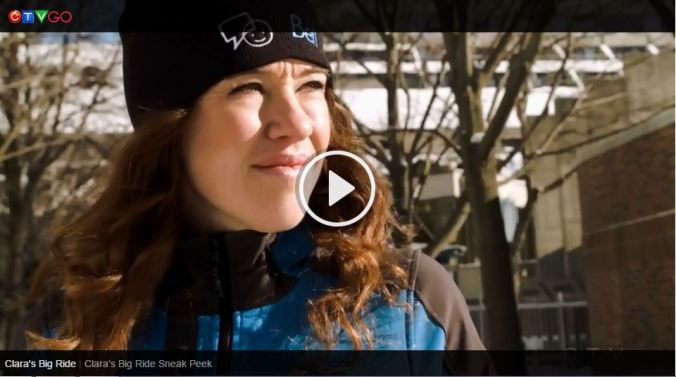
Clara’s Big Ride: Sneak Peek

Hey peeps!

On Monday I announced that I would be part of an incredible documentary that was filmed last year. Now I’m providing you with a sneak peek (check me out at the 1 minute mark!).

Check it out here or click on the image below.

Part catalyst for change and part epic road movie, CLARA’S BIG RIDE is an inspiring new film that tackles the profound conversation about mental health and the stigma that surrounds it.

Capture

On January 28th, a.k.a. Bell Let’s Talk Day the film will be available on demand all day on CraveTV and CTV.ca. Also available on CTV, CTV Two and live-streamed on CTV Go at 7p.m.