Q&A with Kayley and Kyle from Wear Your Label

Wear Your LabelThis week’s blog post is totally different. Thanks to the Twitter gods and goddesses, I was approached to collaborate with a super cool Canadian mental health organization called Wear Your Label (WYL).

If you don’t know, WYL is a conscious clothing line that aims to bust mental health stigma by starting conversations about mental illness through clothing. Their garments are designed to help consumers feel connected with their own story by using positive messages like “it’s okay not to be okay” and garment tags that teach you self-care. For WYL it’s more than just about clothes, 10% of profits go back to mental health organizations.

So who’s the dynamic duo behind WYL? That would be Kyle MacNevin, 22, and Kayley Reed, 21. The pair met in December 2013 while working on a youth engagement workshops for a provincial mental health organization. Both Kayley and Kyle have struggled with their own mental health issues: Kayley with anorexia and Kyle with Generalized Anxiety Disorder, but to them it’s nothing but a a label. On their website they explain:

“Our struggles with mental illness, and our experience working with mental health organizations, are what inspired to start the brand.”

If being engaged in various mental health initiatives and being budding entrepreneurs wasn’t enough, Kayley and Kyle also sit on the Youth Advisory Council for ACCESS-Canada, a $25 million initiative to improve mental health services across the country,

Wear Your Label has appeared in MTV, Cosmopolitan, Seventeen Magazine, Buzzfeed, Bustle, and The Today Show among others, and now Kayley and Kyle are gracing us with their presence to do a little Q&A on Mad Girl’s Lament! So my mad lovelies, give them a warm welcome (virtual wave!).

t's okay not to be okay

Why did you choose clothing as your vehicle to busting mental health stigma?

Continue reading

Just because I don’t look sick, doesn’t mean that I’m not suffering

I’ve been thinking a lot about appearances (thank you Miss Allie Burke!) and how it relates to mental illness. I’ve been thinking about how we look can often give people an impression about our health. When you think of someone who has a mental illness what comes to mind? Is she well groomed and stylish or is she disheveled and dirty? There is a common misconception that to have a mental illness one must be unkempt.

I remember my first time visiting a counselor. I was in second-year university and I had just been caught by my best friend  with cuts all along my arms. My friend was scared for me after I admitted to having suicidal thoughts. I didn’t know at the time, but I was in the throes of a major depressive episode. At the time I didn’t even know what depression was. I was 18, living away from home at a university that had once been fun, in a program that I enjoyed, but all of that had fallen away. I hated everyone there. I didn’t understand how everyone could party so much. I didn’t get how my roommates were so messy. I couldn’t keep up with the demanding reading schedule of my classes and I was struggling with a long distance relationship. No wonder I was feeling depressed. Now some people could have dealt with the pressure of that life. Some people could have adapted. But what I have learned, after 10 years of dealing with my mental illness, is that I don’t handle stress well. Stress aggravates my condition, which interferes with my sleep and as soon as I’m not sleeping I know my mental health will quickly move down hill.

Bitch pleaseSo, my friend being the smart cookie that she is forced me into university counselling services the very next day for an emergency appointment. The appointment had been made a few hours before I had to go to class and I hadn’t given any real thought to what I was wearing. Oddly, I remember exactly what I wore that day. I paired my jeans with a fuchsia pink lace cardigan (that covered the cuts) with a matching fuchsia camisole underneath. I had never seen a counselor before in my life, but I was struck when she pointed out my outfit.

“Well you’re dressed nicely today, you don’t look like you’re struggling.”

How was I supposed to look? Should I have shown up in her office in pajamas with greasy hair and body odor? Is that what we think a person struggling with mental illness looks like?

And this wouldn’t be the only time this happened to me.

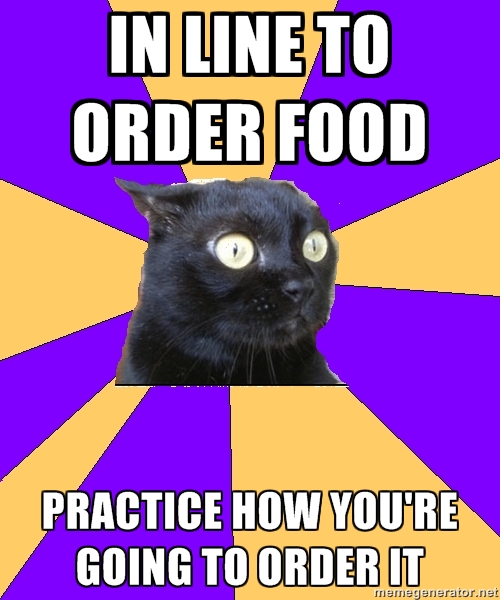
Anxiety CatMany years later, after I was well schooled in the mental health system and seen various psychiatrists and psychologists. I had already been diagnosed with bipolar disorder and was in the throes of another depressive episode, but also dealing with extreme panic attacks. I melted down in a grocery store on an errand to buy napkins for my mother. There were simply too many choices and my heart started racing, I couldn’t breathe, and the aisles were closing in on me. The cacophony of the store was overwhelming and the I lights were too bright. I don’t even remember if I bought napkins in the end or if I just ran out of the store. At this time I had also lost the ability to order food in a restaurant. Whenever I went out for dinner with my then boyfriend (now husband) I would just order whatever he was eating.

I was incapacitated by anxiety. Coupled with the crippling depression and suicidal thoughts, the only thing I could think to do was to be admitted into the hospital. I was speaking with the admitting psychiatrist who had been dealing with my case who said: “You don’t look like you have anxiety.”

How was I supposed to look in that moment? The anxiety had passed. Should I be crying? Panting? Suffocating like I had been in the grocery store? I was severely depressed, but I wasn’t in the middle of a panic attack. In a few words, this doctor had dismissed me based on how I was presenting to him in that moment. He made me feel like shit. He made me feel like I was pretending to have severe anxiety (because being admitted into the hospital was something someone did for fun!)

Over the years I have realized that I use clothes and make up as an armor to protect myself from the assuming eyes of doctors and society. When I’m in the depths of depression or dealing with severe anxiety, I ensure that I am well put together with a face full of make up so that no one knows how I’m struggling. Except that this has worked so well that even doctors don’t believe me when I’m asking for help. It’s like they’re expecting a neon sign, blinking above my head, saying: “She is experiencing bipolar depression. She is having extreme panic attacks.” Or they are expecting me to show up unshowered, in sweats, and matted hair. That’s just not me.

Every day we make assumptions about people based on what they’re wearing. But people, and especially doctors, need to remember that there’s no “look” to mental illness. Anyone can have depression, anxiety, post-traumatic stress disorder, borderline personal disorder or whatever else. Just because I don’t look sick, doesn’t mean that I’m not suffering.

No one gives a fuck: My journey through the mental health system

I sat in my doctor’s office crying. It was my biweekly appointment with her and the blanket of depression was heavy on my shoulders. The sun was streaming through her window and I could see kids playing in a field. I hated the sun and its promise of spring. I hated the careless way the children could play and laugh. There is nothing careless about being depressed.

“I don’t know what to do,” I said, putting my face in my hands. “It’s going to be another month before I see a psychiatrist.”

“Well there’s always the Douglas,” she replied gently. The Douglas (Douglas Mental Health University Institute) is the mental health hospital in Montreal. She knows my fears about being admitted into the hospital — I swore to myself it would never happen again. And I’m always weary of presenting myself to any ER for the fear that they will decide it’s best to keep me. Although apparently no one keeps you anymore, unless you’re suicidal or homicidal — and even then it’s unlikely.

I sighed and nodded my head, unable to speak. She quickly typed out the referral to the hospital while I texted my husband. How many times have he and I gone through this? How many hours have we spent in ER waiting room in the 10 years we have been together? Too many.

He picked me up and I got into the car in tears. I could tell by his tense posture that he was nervous, but he would never say that because he wants to be strong for me.

We arrived at The Douglas and walked into a decrepit building. It’s under construction and there was plywood and construction signs everywhere. A security agent greeted us and asked us what we were here for.

“We need to go to the ER,” I said.

“Who is the appointment for?” She looked from me to my husband. Her english was heavily accented with a Quebecois accent.

Ashamed, I replied “Me.”

“I need to search your affairs,” she pointed to my purse and the bag we carried that was full of my pills.

This was a first for me. I had never had my things searched before going into an ER. She took the pens, all of my pills, my keys, my umbrella, and my cell phone charger. She did the same for my husband and took just his keys. His little box of belongings was able to remain with her in the security booth. Mine were going upstairs.

She escorted us into the ER waiting room and there was already someone checking in. He looked normal, like me. There was no neon sign hanging over his head flashing “I have a mental illness!”

“If you need any of your items, they will be locked in this room,” said the security agent. My stomach clenched, they were already locking away my stuff.

We checked in and sat and waited. And waited. And waited. It was over an hour and half before a nurse called my name to do the preliminary interview. I’ll spare you the details of the interview because they’re boring. It was just a series of questions about my current and past mental health. Questions about my family. Questions about my life. Questions that if were asked in any other context would be intrusive. Finally, as we were coming to the close of the interview, the nurse said: “Why did you come here?”

“My doctor referred me.”

“I know, but usually we don’t serve people from your sector. It’s hard for our intervention teams. You will see a psychiatrist today but you will probably be sent to another hospital.”

I completely deflated at her words. It took everything inside of me to not start crying or throw a scene. First, I felt like this hospital was my last hope. It was a specialty hospital for people like me. Second, this wasn’t the first time I have been in crisis and been turned away from a hospital. A number of years ago, I was trying to get into another specialty hospital in Ontario and spent over 4 hours waiting in the ER with my father and then boyfriend (I told you, this isn’t my husband’s first rodeo) only to be told they didn’t serve people from my “catchment area.” At that hospital I didn’t even see a psychiatrist on duty. They just sent me packing. They refused to serve me because of my area code. What happened to the “do no harm” slogan of doctors?
keep-calm-and-talk-about-mental-health-2

You see, people in mental health advocacy always talk about “seeking professional help.” Well that’s all fine and dandy, but what if no one wants to help you? More and more, I’m realizing that no one fucking gives a shit about me or anybody with a mental illness. The only people who care, like family and friends, have no power to do anything and are left feeling frustrated and helpless as they watch their loved one deteriorate further and further.

Private psychiatrists aren’t taking new patients, those in the public system work less hours because there’s no money which means wait-lists are getting longer, and no one fucking gives a damn. Policy makers, politicians, and doctors themselves just don’t give a fuck. I spent over a month getting trying to get an appointment to see a social worker who would put me in the queue to see a psychiatrist. It was going to be another month before I actually saw a psychiatrist. The reality is, I could be dead by then. Mental illness isn’t terminal, but people die all of the time because of it. And so, in a time of crisis, I turn to a hospital that is supposed to be dedicated to helping people like me only to be told: “We don’t serve people in your area” is fucking ridiculous.

Luckily, the psychiatrist agreed to keep seeing me. Although our meeting wasn’t exactly reassuring. He explained to me what bipolar disorder was (Dear sir, I’ve been diagnosed for at least 8 years with this, I know what i have thank you very much). I left with a script for lithium, a requisition form for blood work, and zero reassurance that anyone gave a shit if I lived or died.

I’d have to call to get my next appointment with him (an aside, I tried calling the THAI clinic where he works about 3 times this week and left 2 messages and I have yet to book my next appointment with him), which would be in a month. He’s giving me a script for a toxic substance and a month seems like a reasonable time to see me again. Oh yeah, he also gave me a blank blood requisition form and told me to photocopy it and fill it out myself based on the one requisition that he completed; Is that normal? It didn’t seem normal.

So even though the psychiatrist saw me, and will keep seeing me, I don’t necessarily feel like I’m in good hands. My parents are so jaded by the system that they have told me to seek out a private U.S. program and they’d foot the bill. But the reality is, they shouldn’t have to. There has to be a psychiatrist somewhere here in Canada who actually cares about patients. There has to be someone in charge somewhere who wants to see a change in the mental health system. Someone other than those of us who suffer from mental illness has to give a fuck whether we live or die.

But I’m not so sure.

Food, tasty with a side of shame and guilt

Trigger warning: Discussion of food and disordered eating.

When was the last time that you ate something without thinking about it? And by that I mean, when was the last time you ate something without weighing the positive and negative consequences that that food stuff may have on your body? When was the last time you ate a chocolate chip cookie without playing mathematical gymnastics as you count the calories you’ve consumed for the day minus the calories you’ve expended?

For me, I can’t even remember.

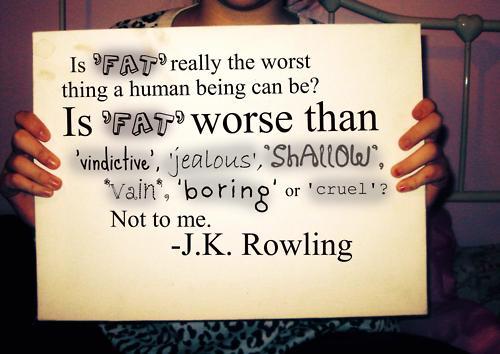
JK Rowling

I don’t know when it was that food became laden with guilt, shame, and turned into a complete mathematical nightmare. But I imagine it was probably around the same time that I hit puberty and realized that I was much bigger than most of my classmates. I don’t mean bigger in that I was chubbier or obese, but I was quite literally the tallest kid (male or female) in any class. My friends could still fit into children’s wear and I was shopping at women’s stores.

It was probably also around the time that I was swimming. I started competitive swimming around the same age and spent 8 to 10 hours a week in a pool. I also spent 8 to 10 hours a week with girls whose bodies had barely any body fat. The other girls walked around the pool deck on their toothpick legs, thighs never rubbing together in the humidity (they had what we now call the thigh gap), without a towel covering their non-existent cellulite.

Watching these lithe swimmers was the beginning of when I stopped thinking of food as nourishment. Food was not something to make my body stronger or make me swim better. And it definitely wasn’t something that I could enjoy without consequence.

SupermodelsMy obsession with food became worse when I decided that I wanted to be a model. I had been watching Fashion Television with Jeanne Bekker since I was 6. I watched Naomi, Cindy, Christy, and Claudia prance down runways wearing clothes that I didn’t understand but loved. I made my Barbies imitate these glamazons and made my sister play Supermodel with me. My love for fashion and supermodels, coupled with the fact that when I hit puberty people kept telling me I should be a model (I guess because I am tall?) wanting to be a model seemed like a natural decision.

What I learned very quickly was that being tall wasn’t enough to be a model. Agencies were looking for a tall girl with a unique face who had very precise measurements; measurements I didn’t have. However, the agency woman who had sized me up (literally, she had taken a tape measure to me) assured me that if I stuck to a healthy regimen and worked out (they didn’t want unhealthy girls here, oh no!) that I could probably be a model.

That summer I spent carb-less, counting and weighing all of my food, and working out like a maniac. I ate my 1/2 cup of All Bran Buds with my low-fat yogurt cup and kept my hunger pangs at bay throughout the day with countless cups of coffee (it wasn’t like it was going to stunt my growth), diet coke, and if I was too dizzy juice. At dinner I ate very small portions of whatever my mom cooked, minus whatever carbohydrate she would put on the table. I returned to the agency in the fall with the exact measurements I was missing 2 months earlier.

At 5’10” I weighed 115 lbs. I was cold all of the time. I was ravenously hungry. But the agency said I could be a model, so it was totally worth it.

As you can imagine, this eating regimen couldn’t last forever. Despite fasting during the day, when I got home from school, I couldn’t stop myself from raiding the pantry. I would shove spoonfuls of peanut butter into my mouth while crunching down on chocolate chip cookies. I would eat ice cream directly from the tub while crumbs of chips were on the front of my shirt. I would eat until I felt sick. And it wasn’t just at my own house that this would happen. I used to babysit for a family across the street and as soon as the kids were in bed, I would snack on whatever they had in the house. To this day I think they had a nanny cam and stopped letting me babysit once they saw me shoving my face with all of their food.

I was binge eating, without the purging. As you can imagine, this eating pattern made me slowly start putting weight back on. I would measure myself and was seeing myself grow in the process. I hadn’t booked any real modelling work and told my mom, “I don’t want to be a model anymore. I’m too hungry.” And that was the end of my career.

Unfortunately, it was just the start of a pattern of disordered eating that follows me to this day. I am currently the heaviest I have ever been, mainly because of the anti-psychotic Seroquel. It causes cravings for carbohydrates. It overrides the brain’s “I’m full” sensor and wreaks havoc on my metabolism. It also makes it incredibly difficult to lose weight. Some days I am embarrassed by my current body while other times I just don’t give a fuck. Except no matter how I feel about my body, I still feel the same way about food; it’s the enemy.

salad

Seriously this was the best salad ever.

As I get older, I’m slowly trying to approach food in a different way but my disordered eating is deeply embedded in who I am. I am trying to value food as either good or bad based only on its relation to my health. Eating a beautiful salad is preferable to a bacon cheeseburger with fries because the nutrients in the salad actually fulfill dietary needs. The cheeseburger fills a craving or laziness because I didn’t prepare my lunch. However, even as I eat a salad filled with healthy items like avocados, berries, quinoa, arugula, and feta cheese — I wonder, wouldn’t it be better if I just didn’t eat? I still value skipping a meal over nourishing my body. And that makes me incredibly sad.

It makes me even sadder because I know there are countless other women and men who think just like me. There are many other people who are so embarrassed by their bodies that they almost kill themselves trying to attain an unobtainable goal — like that pesky thigh gap. I am lucky that I do not have a full blown eating disorder because they take lives.

But, I would like to be able to eat a damn chocolate chip cookie without wondering how many calories are in it.

My breakup letter to alcohol

Dear Alcohol,

You and I have had some fun times. Wino Wednesday with my best friends, which almost never really fell on a Wednesday but seemed to funnier to name it. Numerous pints on patios with colleagues after work to blow off steam. I’ve enjoyed you at whiskey tastings and wine pairings; there was this particularly amazing one in San Francisco where someone had the amazing idea to pair you with chocolate. I have shared incredible bottles of amarone with my partner over fancy home cooked meals that were better than anything we could get in a restaurant.

Despite all of these great times, there have been countless others where you have caused me, and those I love, shame and embarrassment.

Me & my friend E. during Halloween at Bishop's University -- beers in hand.

Me & my friend E. during Halloween at Bishop’s University — beers in hand. I was 17 in this photo.

Let’s rewind to first-year university where I ended up in the university “drunk tank” too many times that I started giving fake names to avoid mandatory alcohol abuse meetings. There was that sleepover in grade 11 when I passed out after consuming countless jello shots and Peach Schnapps (the drink of choice for any well respected high school girl) after a particularly cruel boyfriend broke up with my via e-mail. I collapsed mid speech about how all men were bastards and “we were all fucking fabulous!”

Or what about that time the same wino Wednesday ladies and I got so bombed during a birthday dinner that a taxi wouldn’t take us home. We had to wander until we (me) sobered up. Oh and what about that work party that colleagues had to call my parents to come and get me because I was puking in the bathroom? Or, even more embarrassing, almost five years ago when my grandfather suddenly passed away and I got blackout drunk after his funeral in front of family and friends. My husband and parents had to put me to bed.

Now a lot of this behaviour most people would chalk up to youth and sheer stupidity, and I would agree. A lot of these stories happened when I was between 16 and 21. This was before I learned about tolerance and when to trade you for water. But there are still these moments (more than I wish to admit), even at 29, where I get so drunk I’m puking in a bathroom or waking up with a wicked hangover trying to piece together what happened the night before.

I have been so open and honest in this blog — more honest than in “real” life — that I sometimes find it frightening how much the public knows about me and my struggles. But this is one thing that I haven’t addressed. It’s a secret that I’m even afraid to admit myself. It is the last card that I hold to my chest.

I self medicate with you, alcohol. And I particularly abuse you when my mental illness is triggered. This means that I am either floundering in depression or enjoying the high tide of hypomania.

10400495_539304528140_3669_n

A family photo from my convocation. That’s me in the middle row on the far right and my grandfather is on the left of my sister who is in the middle.

Let’s use my grandfather’s death as an example. I loved that man more than anything. He was taken from me in a flash, a month before I got married. I have so many incredible memories of me and him from when I was a child and just seeing a picture of him now still brings me to tears. Hearing a Johnny Cash song brings a swell of emotions so strong that I often have to stop and remind myself to breathe. I found a book of poetry by Robert Service and had to buy it just because it reminded me of him. I have become Scrooge at Christmas because, to me, he was the embodiment of all the Christmas-spirit. He used to have Christmas Tree parties where everyone bundled up and cut down fresh trees and then the house would be filled with 20 to 30 people as they celebrated the holiday season. He would always be there on my own birthday (December 18). His birthday was December 31st and he always said he was born to party.

This New Year’s Eve I drank gin martinis just trying to get through it, and ended up where I usually do with you when I’m that upset, puking in some bushes.

Many of these moments where I’m drunk, stumbling, and puking correlate to a moment where I was feeling like utter shit. Despite the infinite number of therapists I have seen over the years, I struggle to vocalize and identify negative feelings and dealing with them. It’s just easier to drink until I’m numb.

Do I think I’m an alcoholic? Absolutely not. I don’t drink to function. I don’t drink every day or even every week. I can easily go months without touching a glass. However, what bothers me is that when I do choose to drink it’s always over the top. It can never be a glass of wine, it has to be several. It’s never one pint, it’s five. I have no sense of moderation. This is part of my personality and my bipolar disorder. I have an extreme personality and I either go in 110% or I don’t do it at all.

With my recent bipolar instability I have realized that consuming you, alcohol, just isn’t an option. Every time I touch a glass of something, I risk becoming drunk. Besides, I know you fuck up my mood. Plus, with the amount of medication that I take, I know you’re not great for my liver. And, any bipolar expert will tell you that you’re a big no-no. I mean, it says it right on the bottles of pills I take, but for the past 10 years I have ignored the warnings in an attempt to fit in, in an attempt to numb the way I feel.

So alcohol, you and I are taking a break. I don’t want to say it’s a break up because I don’t want to put that pressure on myself. But those pints on patios will be few and far between, I’m glad I live far away from my two best friends because Wino Wednesdays are no longer a thing, and those beautiful bottles of wine will almost never happen.

I might see you again in the future, but right now you need to go.