5 things I’m grateful for in my mental health journey

I’m not exactly known as the most positive person in the world. I tend to be a catastrophic thinker that always assumes the worst in people. Because, you know, the world is filled with sharks who will rip you to shreds the moment they smell blood.
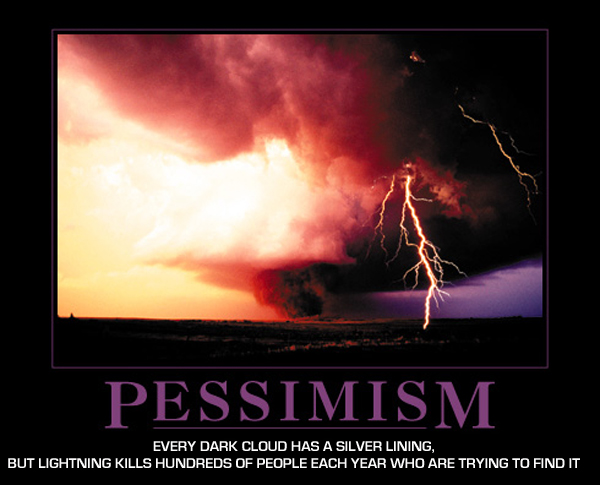
pessimism

However, since I started trying this whole mindfulness thing this past summer in an attempt to address my perfectionism I have been trying to think more positively. I try and choose one or two things that happened in the day that I can be grateful for and write them down. It’s a method of showing myself that I’m making progress.

So, since it’s (Canadian) Thanksgiving I thought I would try and write five things that I’m grateful for right now in terms of my mental health journey.

    grumpy-cat-thanksgiving

  1. I have a good psychiatrist! I know, your jaws are hitting the floor right now to hear that I, of all people, have admitted to having a good psychiatrist. She’s a psychiatry resident in her fourth year and I assume she just hasn’t been beaten down by the system yet (see negative person). Regardless, I get the pleasure of being her patient.

    And why, you may be asking, is she so awesome? She listens to me.I told her, “I’m very sensitive to medication and their side effects.” Her response? “Let’s carefully change your medication and when I add something we’ll always start at the lowest possible dose.” Imagine a psychiatrist actually listening to their patient? Incredible, I know!
  2. I’m in a program specific to bipolar disorder. I just started the program last week and don’t have much to report. However, it is the first time I will be working with psychologists who specialize in bipolar disorder. They are trained to know the intricacies of the illness and coping mechanisms that work best for this illness.
  3. My insurance. Whenever I’m feeling really down on myself, I try and tell myself that it could be worse. I could have no insurance coverage. I’m thankful that my insurance pays for 80% of my astronomical medication costs, 50% for my insanely expensive private therapy, and extremely grateful that I’m receiving 80% of my salary while I’m on disability.

    Without my amazing insurance, my husband and I would be living in the streets and I wouldn’t even have the opportunity to try the multiplicity of medication the doctors have been trying on me.
  4. My family and friends. I have some pretty amazing family and friends. They have been so supportive through this journey that I know without them I wouldn’t be here writing this today. Whether it’s inviting me to grab a coffee, have lunch, or to a party (knowing full well that I might bail last minute) is pretty cool.

    My family is just ridiculously supportive of all the things that I try and do. My parents even offered to pay for private treatment in the U.S. if it meant that I would get better sooner.

    Finally, my husband has been a rock through this entire process. We have been together for over 10 years and he has sat through all of the various ups and downs of my illness; this period probably being the worst yet. He has held me when I cry for hours on end. He goes for long rambling walks when I’m too anxious to sit still. And he knows when to leave me alone. I am surrounded by incredible people who love me a whole boat load and that’s a pretty beautiful thing.

  5. Social media and this blog. Starting this blog and meeting wonderful people like the Stigma Fighters crew and all of you wonderful readers has really given me a sense of purpose and community. When I am feeling really low, I know there are people on Facebook, Twitter, and Instagram who really know what I’m going through. You get me, you beautiful people. Plus, writing about my mental illness journey has given me interesting insight that I have brought back to my therapy sessions. So THANK YOU for reading.

So that’s it folks! Five things that I’m grateful for this Thanksgiving. What can you be grateful for in your mental health journey?

Anxiety, Panic & Paranoia: Just a regular Fall

It’s officially fall. For people without a mental illness this means, pumpkin spice flavoured everything, leaves changing colours, Thanksgiving, and Halloween. Except if you have a mental illness, like me, we are battening down the hatches to brace ourselves against the winter blues. The short, cool, cloud covered days and early nights do not help those of us who struggle with depression. For me, depression is more of a winter thing. In the Fall my anxiety amps up, like it knows I’m preparing for battle. And this Fall hasn’t been any different – other than my anxiety has been more extreme than normal. For the first time in my life, my anxiety is coupling itself with paranoia.

Admittedly, I have always had a bit of a paranoid personality. I’m that person who is convinced that whispering between people is always about me. Or that a person’s bad mood is somehow always my fault. This kind of paranoia I can rationalize. This sort of paranoia is due to my own insecurities, my desire to please people, and always wanting to play the peace keeper.

anxietyHowever, what’s difficult to rationalize is being terrified that someone is following me. When this anxiety creeps around me, I feel like all eyes are on me. It’s like I’m in a fishbowl and people keep tapping on the glass. Recently, I was walking home from the doctor’s office when an attack came over me. There was a man walking a few paces behind me and I was convinced he was following me. I could hear him whistling (a pet peeve of mine), which I was also convinced he was doing on purpose to annoy me. I tried to rationalize that this was extremely unlikely, except my body was sending adrenaline coursing through me telling me to run and get help. The panic got so bad that, despite being five minutes from home, I was going to call my husband to come and pick me up.

It’s not just paranoia that is troubling me, walking outside now feels like a life threatening experience. The sun is too bright and causes pain behind my eyes; staring at the computer screen does the same. The sounds of the city: sirens, city buses, and the whoosh of trucks make me want to curl up into a ball in the middle of the street. I want to shrink among the press of bodies on the sidewalk. And it scares me. With every passing day I feel like I’m tumbling further down the rabbit hole of insanity.

Petrified of how I had been feeling, I told my psychiatrist at the bipolar clinic. While I was there I was in the midst of one of these paranoid, can’t stop moving, panic attacks. She listened with empathy and heard me out (imagine!) and then prescribed me Propranolol while reducing my Latuda from 40 to 20 mg. Propranolol is a beta-blocker and is typically prescribed for people with high cholesterol. However, the drug has been found to reduce anxiety in people by slowing down the heart rate.

anxietyNow, a normal brain would go through that and think, during a panic attack your heart rate increases and therefore a medication that slows down the heart makes sense to take. I don’t have a normal brain. I have an anxious brain. I thought if I take this medication my heart  may slow down too much. What if my heart actually stopped? So I have been too afraid to take it even though it could potentially help me. Instead, before I leave the house, I take my “can’t give a fuck” cocktail of 25 mg of seroquel and 1 mg of clonazepam. And that’s anytime I want to leave my house, which frankly, I don’t really want to do without supervision.

This is the sad and pathetic reality of my life right now. I’m terrified that I might have a full blown attack and lose it in the middle of the street. But I’m lucky that I can retreat to my home when the anxiety and paranoia become too much to deal with. And this makes me think of all of the homeless people in my city that display symptoms of untreated mental illness.

My heart aches as I watch them talk to people only they can see. I can see so many of them are plagued by demons that are not so different than my own. Medically, there’s very little separating them from me. I just got a bit luckier in the lottery of life. I’m receiving treatment. I have a supportive family. People care if I get better. These poor souls are lost and as invisible as I sometimes want to feel. I escape to my home when the paranoia gets too great, where do they go? They have no safe space.

Beautiful Tears: Is being sensitive so bad?

A few days ago I finished reading Open Heart, Open Mind by Clara Hughes. For those of you who don’t know, Hughes is a six-time Olympic medalist who is the only Canadian Olympian to have won medals in both the Winter and Summer games. More importantly (to me) she is also the face of the Canadian mental health initiative, Bell Let’s Talk, and is never hesitant to speak about her struggle with mental illness. If you follow my blog you know that I’m a little more than slightly obsessed with her. She has inspired me to share my mental health story and every time I hear her speak I am reminded of her strength, bravery, and her general bad ass-ery (that’s a word now).

Near the end of the memoir, Hughes talks about life after sport and how it had allowed her to push down her vulnerability and childhood trauma. Now that she no longer had sport to distract and punish herself with, she is forced to face her pain.

…[T]o rescue the part of me still locked in that closet, I would have to admit to my vulnerability. I would have to let my beautiful tears flow.

I, as a child, had suffered through really dark, painful situations that were not my fault, leaving a powerful residue against which I had struggled all of my adult life. I recognized that I carried an ocean of grief inside of me, some of it held back for so long that I no longer knew the cause. My warrior self had served me well […]. Now, I needed to have the courage to accept my wounded self.

Hughes and I come from very different backgrounds, but my own childhood has left the same “residue” that I still struggle to wash from my body. No  matter how hard I scrub, it’s still there. Painful words are indelibly inked on my broken heart. I have been told to “forget about it” or to “get over it already,” but I have never actually faced the pain.

Like Hughes, I spent my life running from it. I have spent my life trying to be so perfect and good that it wouldn’t matter what others said about me. I tried to be the skinniest. The smartest. The coolest (that one never worked because I just don’t like cool things. But I became very good at imitating what made people “cool.”) But no matter how hard I tried, I was never good enough. And to this day, I am still striving for this ideal that only exists in my mind.

Except trying to rid myself of this “residue” has been more than striving for perfection in all aspects of my life. Certain situations and my own biological make-up have made me a deeply sensitive person. Over the course of my life, I have repeatedly heard:

“Marisa is so sensitive”
“You’re being too sensitive
“Why do you have to be so sensitive?”

Being sensitive has only ever been portrayed to me as a negative quality. Sensitivity is a weakness that makes you vulnerable to a world that is hard and cruel. The world has no place for a girl with skin so thin that you can almost see through her. My sensitivity has made me prone to depression. My heart is sometimes too big that I over extend my willingness to help others that I no longer have any love leftover for myself. The world becomes an overwhelming place when you haven’t learned how to protect yourself against the cruelty. The negativity that bounces off of you, pierces my core. I absorb emotionally charged situations until I go into emotional overload and I’m crying.

I begrudgingly admit that I’m a “crier.” Crying is my go-to emotion. I cry when I’m happy. I cry when I’m sad. I cry when I’m angry. I cry when I’m frustrated. It’s all I can do to release the sea of pain that swells in my chest as others around me argue and fight. Like the salt water of the ocean, each day leaves a coating on my skin that burns like acid. I cry to wash it away but it just makes it worse.

I would have to let my beautiful tears flowAlthough more and more, and Hughes’s book reminded me of this, what if it’s not me who is wrong? What if our perception of people and the world is wrong? What if my sensitivity isn’t a weakness or flaw, but a strength and an advantage? My sensitivity allows me to read situations and people. I believe it’s what makes me a good writer, friend, daughter, and partner.

Instead of wanting, aching to be tough like the rest of the world, imagine how different life would be if everyone was as sensitive as me? What if everyone let their beautiful tears flow?

Ride or Die: I’m in this battle with you

I am currently forcing myself to write this just to say that I posted something for you lovelies. Despite having no formal obligation to anyone to write my blog, I feel that I have an understanding with my community (that’s you). You expect a blog post weekly. This is one of the commandments that you form with your readers when blogging: “I will published x posts a week and I must adhere to that schedule.” Unfortunately for you, my mad lovelies, I have broken that commandment time and time again.

The past two weeks have been tough. Depression has been hanging around, not like the familiar lead weights tied to my ankles, making me completely immobile. But it’s more like a wet blanket that I’m forced to drag around. I have tried all of the tools at my disposal to lift the blanket from my shoulders. I’ve listened to music, gone for walks, talked with friends, spoken to my therapist, sat in the sun, read, and coloured. For whatever reason, I just can’t shake it. I watch laughing and smiling people with disdain. The sunlight literally hurts my eyes. I just want it to rain, sit in silence, and stare at a wall.

depressionI think the reason that I’m feeling like this is because I’m feeling stuck in my recovery. When I left the out-patient program I felt like I had hope for my future. I had strategies and tools. I was off of lithium. But that confidence and happiness has fallen away. Now I feel like I’m trapped in a hamster wheel of recovery: doctor appointments, new medication, therapy, and repeat. And this feeling of being stuck in a spin cycle has also translated into me not feeling good enough to write a post. Not that I’m too unwell to literally write, but what advice can I offer you, my mad lovely readers, when I can’t even fix myself? I am exactly like so many of you. I have no insight. I have no advice. I’m just as lost and struggling as you.

Just like providing readers with a regular post, the second commandment is to leave your readers with some kind of take away message. Whether that means you’ve learned something new, come to some kind of insight, or enjoyed the storytelling. At the moment, I don’t feel like I’m able to achieve any of those things in my posts. The frustrating part is that this is all self-imposed pressure. I have no boss whipping me to get a story out. Many of you, I don’t even know personally. Yet, I still feel this sense of obligation to deliver.

I know many of you that read this blog look to me to offer words of wisdom about mental health or recovery or be some sort of beacon of hope for those of you who are struggling right now. I guess all I can say is that I’m in this fucking fight with you. I’m a ride or die bitch.

Do psychiatrists perpetuate the stigma of mental illness?

Time to Change, a British mental health organization dedicated to ending mental health stigma, partnered with the country’s National Health Service to address the issue of the stigmatization and mistreatment of patients within the mental health care system. A study conducted by Time to Change, published in the British Journal of Psychiatry, found that between 2008 and 2011 there was a drop in mental health discrimination within the general populace in the UK: “the average discrimination ‘score’ reported by people fell by 11.5%.” However, the study found “‘no significant reduction’ in the level of discrimination people reported from mental health professionals.” All of the incredible work conducted by great mental health organization’s like Time to Change has not impacted the way mental health professionals treat their patients. But frankly, I’m not surprised.

I have been diagnosed with Bipolar Disorder II for the past 10 years. Bipolar II is characterized by hypomania and depression. So I have gone through periods of hyper-productivity, hyper-creativity, and general hyperactivity. However, I have also experienced the darkest depths of depression. I have had suicidal thoughts and have self-harmed. I have been through the byzantine bureaucracy of the mental health care system in Canada on several occasions, and I can attest that the UK study isn’t wrong.

psychiatryWhen talking about my mental illness with people, I’m often asked about the stigma I have experienced and my answer often surprises them. I have never experienced stigma from friends, family, or employers. Of course, there is always one idiot in the crowd who says something stupid, but overall, stigma for me, hasn’t come from the layperson. The biggest form of stigma, as the Time to Change study reported, was from mental health professionals. The biggest offenders, in my experience, have been the psychiatrists and I’m sick and tired of it.

Crazy Cat Lady

The epitome of the crazy lady. I even have a cat now!

One psychiatrist told me that I was pretending to have a mental illness because I displayed atypical symptoms of the disorder. He found me too well-dressed, too well-spoken, too composed to be experiencing anxiety attacks or depression. Apparently I should have been a bedraggled, blathering idiot who was foaming at the mouth, because that’s what depression and anxiety look like. A psychiatrist once told me that my self-harm and suicidal thoughts were just attention-seeking behavior and that my mental illness was my fault. Another psychiatrist told me that I shouldn’t have children because they might inherit my mental illness, as if I’m some kind of monster who shouldn’t procreate.

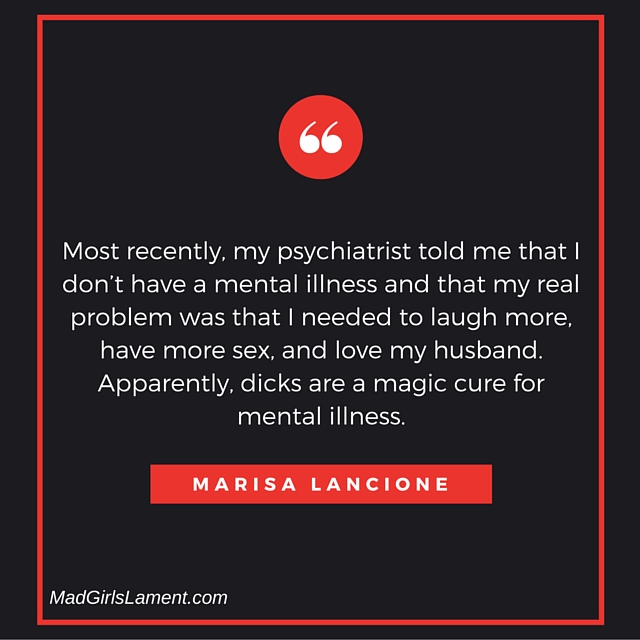
Most recently, my psychiatrist told me that I don’t have a mental illness, and that my real problem was that I needed to laugh more, have more sex, and love my husband. Apparently, dicks are a magic cure for mental illness! Someone give this doctor the Nobel Prize for Medicine because he found the cure for all mental illness — a penis. Oh wait, scratch that, I don’t actually have a mental illness, I just need to be fucked. If we were in Victorian England, this would have been a normal response to female mental illness. Sex and masturbation was how they “cured” (I use that term loosely) women of hysteria (which no longer exists as a diagnosis). But we’re not in 19th century London. This is 2015, in Canada, and this doctor is treating me like I’m just a miserable, frigid wife who isn’t submitting to her female duties.

I am so sick and tired of arrogant psychiatrists who dismiss and infantilize me, like I’m a dumb, attention-seeking girl who just needs a good lay. Over the past 10 years I have seen four separate psychiatrists, all more offensive and useless than the next. I don’t know if it’s because they’re overworked, underpaid, and generally stressed, but if any other professional treated their “customers” the way psychiatrists often do, they would quickly find themselves out of business.

This article originally appeared on Ravishly.